
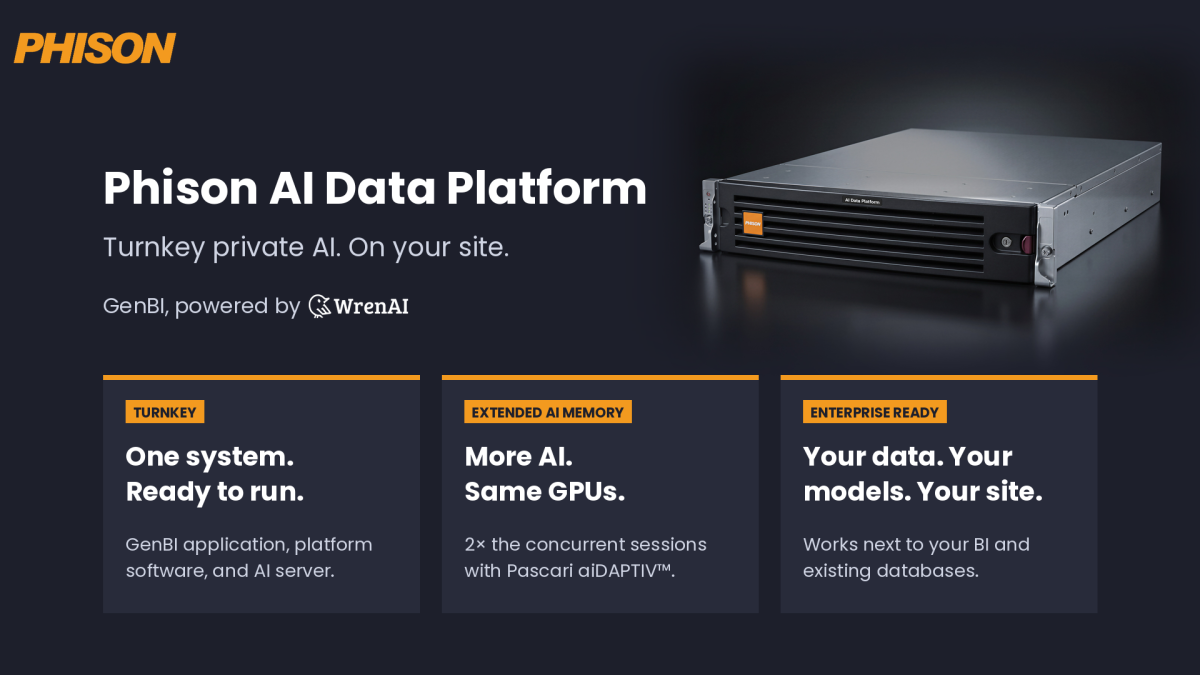
Unveiled at SC26, GenBI is the first business solution on the Phison AI Data Platform. Ask any question about your own data in plain language and get a specific answer on the spot, then turn it into a custom dashboard or report. All from one private system, with no AI stack to build.
Consider a manager who wants to know which suppliers caused last month’s delivery delays. It sounds like a simple question. For most managers, getting the answer is anything but. Traditional business intelligence (BI) tools often rely on predefined dashboards, and if the dashboard doesn’t already show it, the request goes to the data team. Someone writes a new query. The manager waits. Then a follow-up question starts the whole cycle over again.
Cloud AI tools can answer in plain language, and they’re quick. The catch is that your data has to leave your building to get there. For banks, hospitals, manufacturers, and many other regulated companies, that’s off the table.
Building private AI in-house is the other route. That means buying GPUs, choosing models, standing up software, and building an application on top. Most teams don’t have the time or the specialized skills to pull it off.
Phison AI Data Platform: GenBI brings those pieces together in a smarter way. Business users get fast answers in plain language, and the data never leaves the building.
What’s new at SC26
Phison introduced the AI Data Platform in June. At SC26, the company launched the first business solution to run on it. GenBI lets people ask questions about company data in plain language and get trusted answers back.
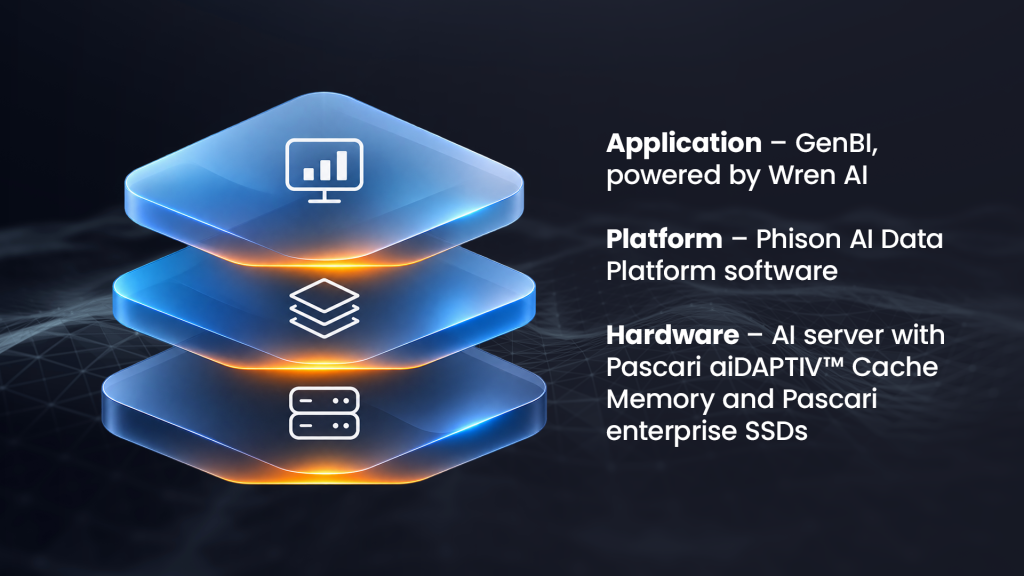
GenBI arrives as one integrated system with three layers:
- Application – GenBI, powered by Wren AI
- Platform – Phison AI Data Platform software
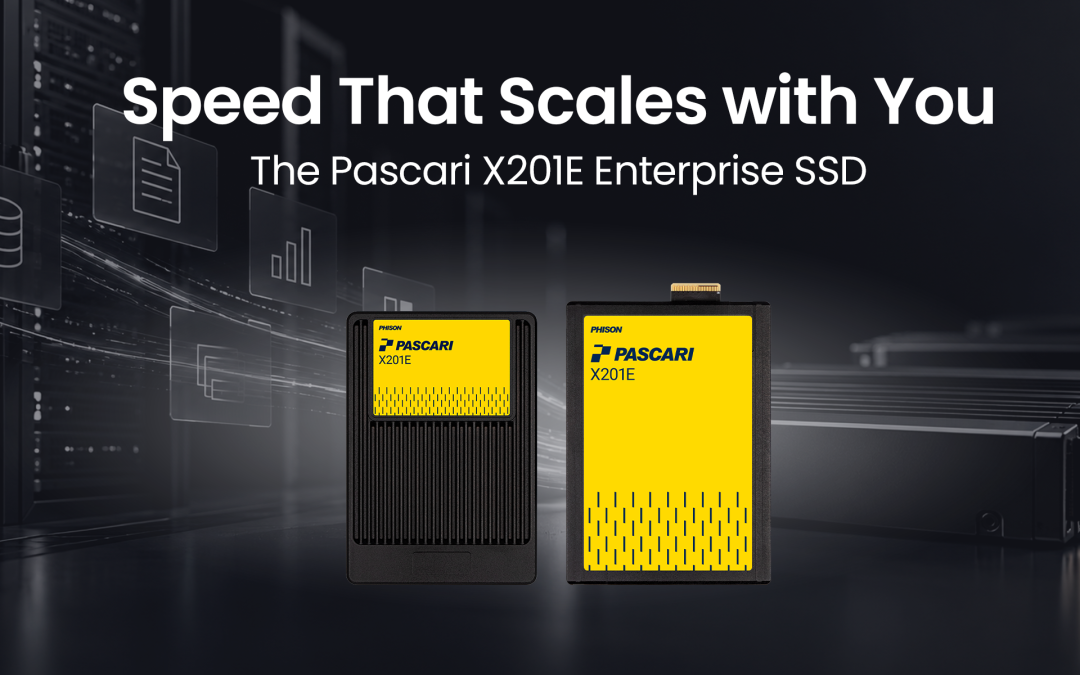
- Hardware – AI server with Pascari aiDAPTIV™ Cache Memory and Pascari enterprise SSDs
Phison delivers all three together, so your team has no AI stack to assemble.
How it works
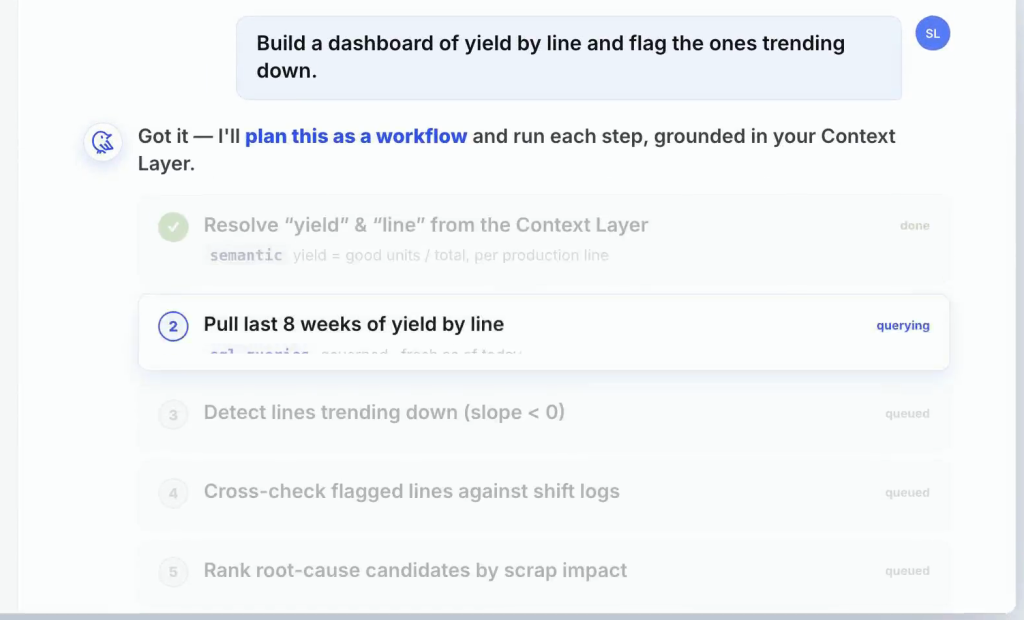
GenBI takes four steps to get from a question to an answer you can trust:
- Connect – Wren AI queries your databases in place. Your data team approves which tables it can use.
- Define – Set business terms like “revenue” or “active customer” once. From then on, every answer follows your rules, and two
- people asking the same question get the same result.
- Ask – Anyone can type a question and keep going with follow-ups in plain language. Nobody has to write SQL.
- Check – Answers come back as a chart, report, or dashboard. Each one shows the SQL behind it, so analysts can see exactly how the result was built.
GenBI works for AI agents too. Through APIs and Model Context Protocol (MCP), agents can tap the same governed data and business definitions your people use.
Why keep it private
With GenBI, your data, prompts, answers, and models all stay on your site. Nothing is sent to a cloud LLM.
Cost matters here, too. GenBI is a heavy token user because every question carries your schema and business terms along with it. In the cloud, you pay for each of those tokens, and the bill climbs with every new user. On premises, there’s no per-token charge at all.
You also keep full control of the stack. Your team sets the security policies and decides when upgrades happen.
Get more work from the same GPUs
Every user session needs memory to hold its AI context, known as the KV cache. GPU memory is small and expensive. Once it fills up, sessions slow down, and supporting more users usually means buying more GPUs.
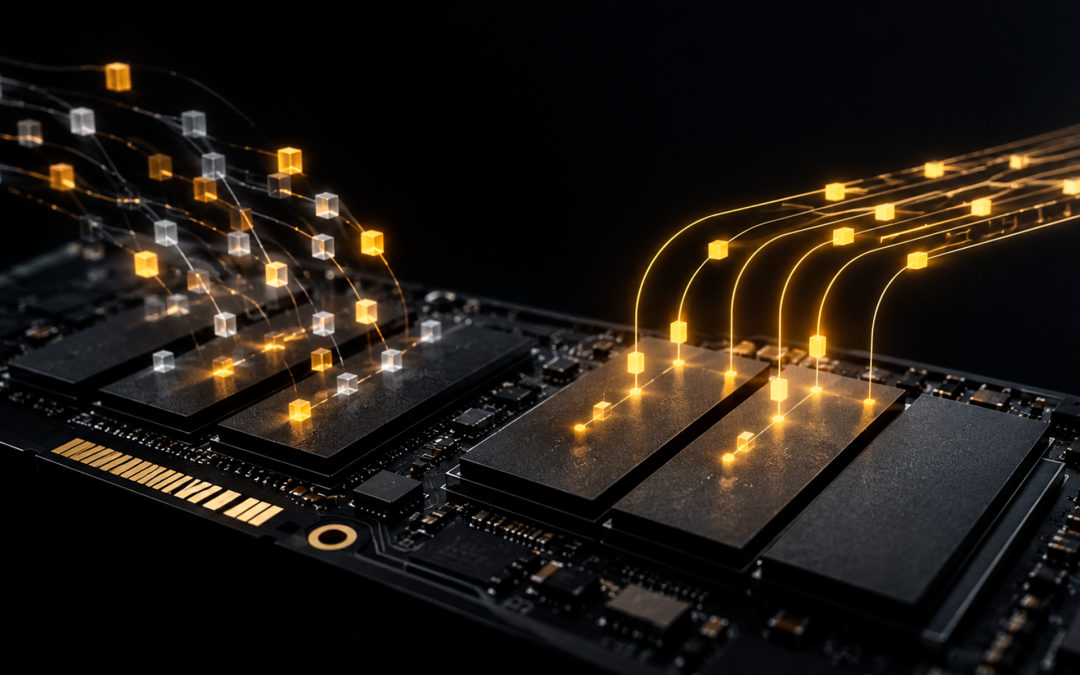
Pascari aiDAPTIV adds a flash memory tier next to GPU memory. Context that isn’t in use moves out to flash, then comes right back when a session needs it again.
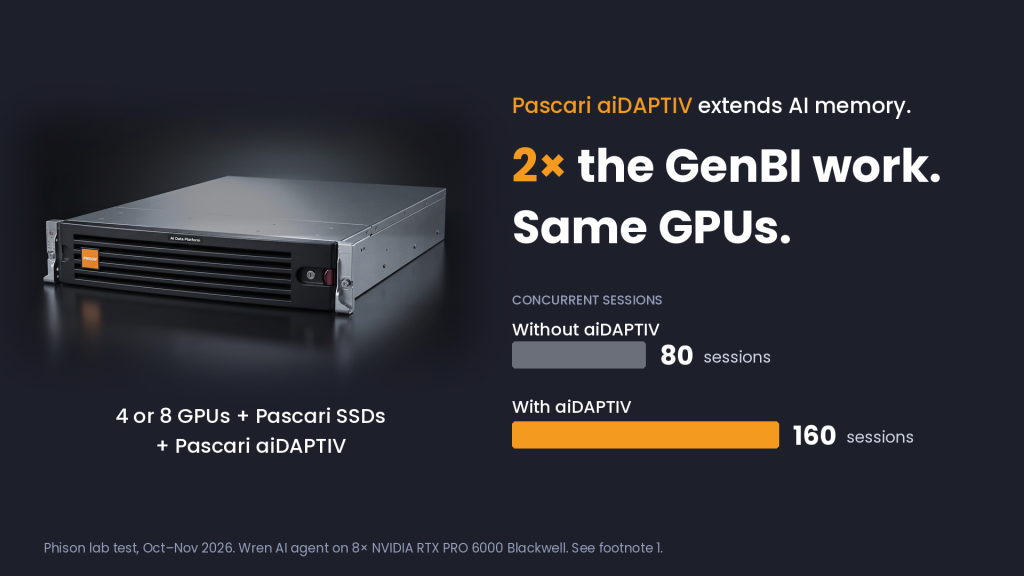
The results are hard to ignore. In Phison lab testing with the Wren AI agent, a single 8-GPU server with aiDAPTIV supported 160 concurrent sessions at the response target. Without aiDAPTIV, the same server reached its limit at 80. Time to first token was also 3.7× faster.¹
That’s twice the work from the same hardware. And when fewer GPUs can handle the job, you save on power, cooling, and rack space.
Backup built in, with TrueNAS for more protection
Backup and restore are built into every GenBI system. For teams that want an extra layer of protection, TrueNAS is the first storage partner for the Phison AI Data Platform. A separate TrueNAS system on your site holds an independent copy of your GenBI backups, so your data stays protected and stays in your hands.
“Enterprise customers need effective, trustworthy private AI solutions that deliver data sovereignty while lowering costs,” said Jamila Gunawardena, Director of Solutions and Alliances at TrueNAS. “TrueNAS brings high-performance data services, customer-controlled storage, and data protection to AI workloads, beginning with an independent, on-premises storage target for GenBI backup and restore.”
Delivered by Phison
GenBI comes ready to run. Phison and its partners size the system for your workload, install it, and support it after go-live. AI servers are available with four or eight GPUs.
Start small. Pick one team and one data domain, prove the value, then add users and data sources as demand grows.
Behind it all is more than 25 years of Phison engineering in storage, controllers, and firmware. That work has kept flash reliable under heavy, nonstop load for decades. Now it’s helping enterprises run private AI on their own terms.
At SC26? Stop by booth #5413 for a live GenBI demo and a close look at the AI server. Bring a real business question and ask it yourself.
Can’t make the show? Email us at aidp@phison.com to set up a demo, or vist our GenBI webpage to learn more.
¹ Based on Phison lab testing in October and November 2026 on a single 8-GPU server running the Wren AI 2.5.1 agent and Qwen3.8-27B, with and without aiDAPTIV, at the same response target. Time to first token is the median. Actual results may vary depending on software environment, model architecture, and quantization.
자주 묻는 질문(FAQ) :
What is generative business intelligence (GenBI), and how does it work?
Generative business intelligence (GenBI) uses AI to translate natural-language questions into database queries, retrieve relevant enterprise information, and generate answers, charts, reports, or dashboards without requiring users to write SQL. Unlike traditional business intelligence tools that rely heavily on predefined reports, GenBI supports conversational follow-up questions and dynamically generated analysis. Solutions such as 피슨의 GenBI, powered by Wren AI, also incorporate governed database access, standardized business definitions, and SQL transparency to help organizations 검증하다 analytical results.
How does private generative AI protect sensitive enterprise data?
Private generative AI protects sensitive enterprise data by running AI models, processing queries, and generating responses within infrastructure that an organization controls rather than transmitting information to external cloud-based language models. On-premises deployment enables organizations to enforce internal security policies, control software upgrades, and 유지하다 data sovereignty. 피슨의 GenBI keeps enterprise data, prompts, answers, and models on-site, making private AI analytics particularly relevant to financial services, healthcare, manufacturing, and other industries with strict data governance requirements.
What is KV cache memory, and why does it matter for enterprise AI performance?
Key-value (KV) cache memory stores intermediate attention data that large language models reuse during inference, reducing redundant computation and improving response efficiency across conversational interactions. As context lengths and concurrent user sessions increase, KV cache requirements consume more GPU memory and can constrain system capacity. Flash-based memory tiering addresses this limitation by moving inactive context from GPU memory to a secondary storage tier, allowing AI infrastructure to support larger aggregate context requirements without proportionally increasing GPU resources.
How does generative BI compare with traditional business intelligence tools?
Generative BI enables users to explore enterprise data through conversational questions and dynamically generated analysis, while traditional business intelligence tools typically emphasize predefined dashboards, structured queries, and analyst-developed reports. Generative BI can reduce the time between identifying a business question and obtaining an actionable answer, particularly when users need unplanned or follow-up analysis. However, organizations should evaluate semantic consistency, access controls, SQL transparency, and answer validation rather than assuming natural-language interfaces automatically produce accurate 결과.
Is on-premises generative AI more cost-effective than cloud-based AI analytics?
On-premises generative AI can offer lower long-term operating costs than cloud-based AI analytics when organizations 유지하다 high query volumes, substantial context requirements, and predictable infrastructure 이용. Cloud services typically charge according to token consumption or other usage metrics, while on-premises deployments 제거하다 external per-token inference fees but require investment in hardware, power, cooling, maintenance, and support. Organizations should compare total cost of ownership, concurrency requirements, data sovereignty needs, and expected workload growth before selecting a deployment model.
How does Phison's AI Data Platform simplify enterprise generative AI deployment?
피슨의 AI Data Platform simplifies enterprise generative AI deployment by integrating application software, AI infrastructure management, and storage-optimized server hardware into a turnkey system that 제거한다 the need for customers to assemble and integrate a separate AI stack. Its first business solution, GenBI, combines Wren AI, 피손 AI Data Platform software, Pascari aiDAPTIV™ Cache Memory, and Pascari enterprise SSDs. 피손 and its partners also provide workload sizing, installation, and post-deployment support, enabling organizations to begin with a targeted use case and expand as demand increases.
How does Pascari aiDAPTIV improve GPU utilization and concurrent AI inference performance?
파스카리 aiDAPTIV™ improves effective GPU memory 이용 by extending AI context storage into a flash-based memory tier, reducing pressure on limited GPU 메모리 and enabling more concurrent inference sessions on existing hardware. In 피손 laboratory testing, an 8-GPU server running the Wren AI 2.5.1 agent and Qwen3.8-27B supported 160 concurrent sessions with aiDAPTIV versus 80 without it at the same response target. The configuration also achieved 3.7× faster median time to first token. Results vary with model architecture, quantization, and software environment.
How does Phison support low-latency storage and memory optimization for enterprise AI workloads?
Phison supports enterprise AI memory optimization through the integration of Pascari enterprise SSDs, flash-based cache memory, and memory management software that coordinates context movement between GPU memory and storage. Pascari aiDAPTIV Cache Memory provides an 추가의 tier for inactive AI context, allowing the system to retrieve that context when applications need it. This architecture addresses GPU memory capacity constraints while supporting workload-specific performance optimization. Phison’s controller and firmware engineering 전문적 지식 also provides a foundation for integrating flash storage into demanding enterprise AI infrastructure.
How does Phison's GenBI platform support enterprise data governance and AI agent integration?
피슨의 GenBI platform supports enterprise data governance through approved database access, standardized business definitions, transparent SQL generation, and API-based integration that enables AI agents to use the same governed information as business users. Powered by Wren AI, GenBI queries authorized database tables in place and applies centrally defined metrics to 유지하다 analytical consistency. Support for Model Context Protocol (MCP) extends these capabilities to AI agents, enabling automated workflows to access enterprise information while following the same established data definitions.
How can enterprises scale private AI analytics while maintaining data protection and infrastructure efficiency?
Enterprises can scale private AI analytics by combining workload-sized GPU infrastructure, flash-based AI memory expansion, governed data access, and independent backup systems that support increasing user concurrency without requiring a complete infrastructure redesign. 피손 제공하다 GenBI configurations with four or eight GPUs and uses Pascari aiDAPTIV to increase effective context capacity. Integrated backup and restore capabilities protect system data, while an optional TrueNAS deployment provides an independent on-premises backup target. Organizations can start with one business team and data domain, then expand users and connected data sources as requirements grow.




 한국어
 English
 繁體中文
 简体中文
 日本語
 Deutsch