

Phison brings enterprise-grade speed, responsiveness, and reliability to the next generation of AI-powered automotive systems at the edge.
Automotive storage is evolving to meet data center–class demands as autonomous driving, ADAS, and in-vehicle AI require high throughput, low latency, and consistent quality of service. This convergence is driving new storage architectures that deliver real-time performance at the edge while maintaining the durability and reliability required for automotive environments.
For decades, enterprise environments have set the standard for high-performance computing, processing massive data volumes with high throughput, low latency, and predictable quality of service under demanding workloads.
Those same expectations are now shaping automotive systems. As vehicles add AI, advanced driver-assistance systems (ADAS), and autonomous capabilities, they must process unprecedented amounts of real-time data at the edge, pushing storage to deliver enterprise-class responsiveness in far more constrained environments.
While automotive systems increasingly require high-performance storage, they are still catching up to align with today’s data center performance. Consider that mainstream automobiles currently use UFS 3.1 or 4.1 storage, which delivers around 2.1 to 4.3 Gbps—while enterprise data centers have embraced PCIe Gen5 and even Gen6 SSDs that deliver 14 to 28 Gbps.

How data center standards define modern performance expectations
In data centers, three metrics matter most:
- Throughput, or how much data can be processed at once
- Latency, or how quickly data can be accessed and delivered
- Quality of service (QoS), which ensures performance remains consistent under changing workloads
Historically, automotive storage prioritized durability and retention because vehicle workloads were modest. Today, vehicles generate and process massive real-time streams from sensors, cameras, radar, lidar, and telemetry.
That changes storage from passive infrastructure into an active performance layer that directly affects how quickly AI and other advanced systems process information and make decisions. Automotive storage requires high throughput and low latency today, and will eventually need improved QoS once the industry moves from UFS storage to higher-performance solutions.
Why consistency matters as much as peak performance
In AI-driven vehicles, consistency matters as much as peak speed.
In enterprise systems, inconsistent storage slows applications. In vehicles, inconsistent latency can affect real-time decision-making systems tied to safety and navigation.
That’s why automotive performance increasingly depends on predictable QoS models like those used in enterprise infrastructure.
Data centers have long optimized for scalability, throughput, and performance consistency, while vehicles have emphasized durability, thermal resilience, and real-time responsiveness. AI-driven automotive systems now require all of these at once.
This convergence is reshaping storage architecture across both industries.
Automotive systems are rapidly evolving
Vehicles are becoming sophisticated edge computing platforms that process enormous amounts of data locally.
Three forces are driving this shift:
- Growth of ADAS and autonomous driving
ADAS demands far more from storage than earlier automotive systems. A single vehicle may process inputs from high-resolution cameras, radar, lidar, GPS and maps, driver monitoring systems, and AI inference engines at the same time.
These systems generate continuous data streams that must be ingested, processed, stored, and retrieved with extremely low latency. As autonomy advances, those demands will only grow.
- Explosion of sensor and video data
Combined camera, lidar, radar, telemetry, and AI data can make storage one of the key performance bottlenecks in the vehicle.
Traditional automotive storage was not built for the throughput, low latency, and sustained performance these workloads require.
- Expansion of AI
AI is reshaping automotive infrastructure. Inference workloads need rapid access to large data sets with minimal delay, and even small latency increases can reduce responsiveness across driver-assistance and real-time analytics systems.
As a result, storage performance is becoming tightly linked to overall vehicle intelligence. Vehicles need faster ingestion, higher sustained throughput, lower latency, more predictable QoS, and room to scale for future AI growth.
These are the same priorities that have shaped enterprise storage for years.
The convergence of data center and automotive requirements
The gap between data center storage and automotive infrastructure is shrinking. As vehicles become distributed AI systems, they are adopting many of the same architectural principles used in enterprise and edge computing.
In practice, that means bringing data center-level performance, scalability, and reliability into vehicle systems shaped by AI and real-time processing demands.
Driving at the edge
Edge computing is no longer limited to factories, retail, or telecommunications. Vehicles themselves are becoming distributed edge platforms for local processing, AI inference, and real-time analytics. That creates storage performance demands that traditional automotive architectures were not designed to meet.
The challenge is not just capacity but moving data fast enough to support continuous AI-driven decisions.
Real-time decision-making depends on storage
Real-time AI depends on fast, consistent data movement. Autonomous systems cannot wait for delayed reads or erratic storage behavior.
Low-latency storage is a must for automotive architectures, especially when it comes to loading high-definition maps, for example, or logging data. It affects how quickly systems can analyze conditions, process sensor fusion data and run AI inference, and respond to navigation changes.
Storage is now part of the active compute pipeline, not a background component.
Storage is now a performance enabler
Storage was once judged mainly by capacity and durability. Now it must also deliver predictable latency, sustained throughput, intelligent workload management, and continuous QoS under mixed workloads.
Key takeaways:
- Vehicles are becoming intelligent edge computing platforms
- AI workloads demand data center-style performance
- Consistent QoS is critical to automotive reliability
- Storage now shapes AI responsiveness and system stability

Challenges in bringing data center capabilities to automotive environments
Automotive systems increasingly need data center-class capabilities, but bringing enterprise performance models into vehicles adds five major challenges.
- Thermal constraints
Vehicles operate across wide thermal extremes. Unlike controlled data centers, automotive systems must maintain performance through heat, cold, and environmental stress. That requires intelligent thermal management and controller-level optimization to keep performance consistent.
- Power limitations
Automotive platforms run under tight power limits. Storage must deliver high throughput and low latency without sharply increasing power draw or heat.
Balancing efficiency, performance, and reliability is essential for next-generation vehicle architectures.
- Environmental durability
Automotive systems also face vibration, long lifecycles, intermittent power, and exposure to dust and contaminants. Storage must remain reliable under all these conditions.
That makes firmware optimization and advanced reliability mechanisms especially important.
- Cost sensitivity and scalability
Automakers also face cost pressures while planning for future AI growth. Storage architectures must scale efficiently without adding excessive cost or complexity.
That makes flexible, scalable design increasingly valuable.
- Form factor
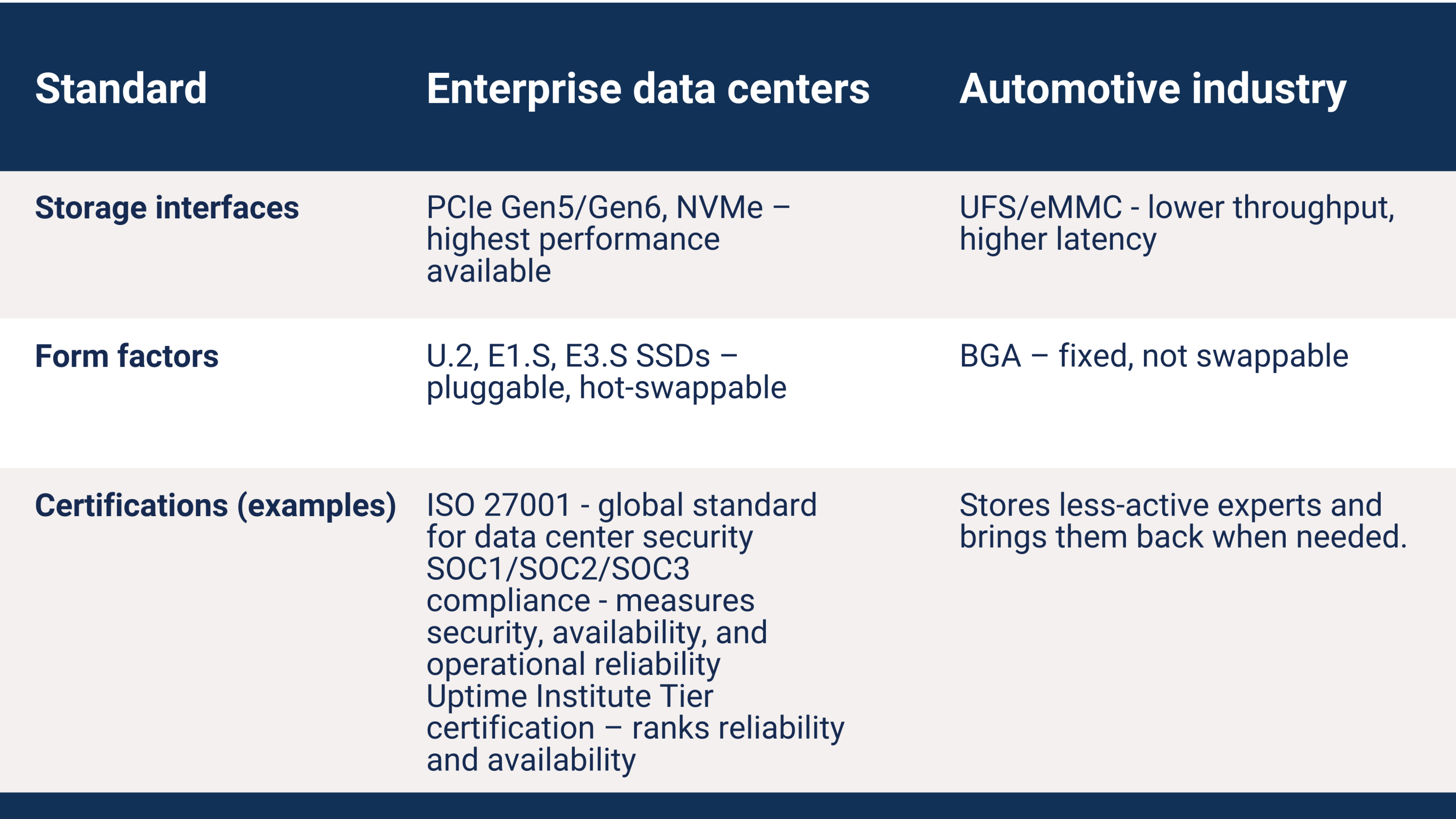
To survive severe vehicle vibrations, more than 95% of auto storage today is embedded and soldered directly on the printed circuit board (PCB). Today’s enterprise SSDs are pluggable/hot-swappable, which means that they’re easy to upgrade for higher performance or greater capacity as needs evolve. Pluggable SSDs also make it easier to recover stored data if a motherboard fails, whereas data on an embedded, fixed storage drive might be lost forever.
Today’s disparity in data center and automotive standards
The differences between data center and automotive standards make it clear that the automotive industry has some work to do to achieve the performance and flexibility of data center storage.As automotive systems evolve and on-board data storage improves, the applicable standards will begin to align more closely with the standards that exist for data centers today.
How Phison is enabling the transition
As enterprise and automotive infrastructure converge, vendors with deep controller and firmware expertise are becoming more important.
Phison designs solutions at the controller and firmware layers, where many of the most critical performance and reliability decisions are made. That enables us to bridge enterprise-grade performance expectations and automotive-grade reliability requirements, particularly in three areas.
- Controller-level optimization
High-performance automotive systems need more than fast NAND. Controller design is critical to consistent throughput, low-latency responsiveness, workload balancing, and efficient thermal and power management.
Phison’s experience across enterprise, embedded, and edge environments helps support real-time AI workloads under constrained conditions.
- Firmware intelligence and QoS consistency
Firmware increasingly determines whether demanding workloads remain predictable. In automotive AI systems, inconsistent performance can disrupt critical real-time operations.
Phison’s firmware optimization helps maintain consistent QoS across the mixed workloads common to ADAS, autonomous driving, and in-vehicle AI.
- A scalable portfolio approach
This convergence also calls for storage architectures that can evolve over time. Our Pascari enterprise SSDs, including the performance-focused Pascari X-Series, reflect a broader approach to scalable performance, reliability, and endurance across demanding edge and enterprise environments.
That flexibility will only grow more important as AI workloads expand across vehicles.

The road ahead for automotive storage
Automotive infrastructure is increasingly resembling distributed edge computing. ADAS, autonomous driving, and in-vehicle AI are pushing storage toward the same high-throughput, low-latency, and consistent QoS models used in modern enterprise systems.
At the same time, vehicles must operate within strict thermal, power, durability, and reliability constraints that make automotive environments uniquely demanding.
Bridging that gap requires more than adapting storage hardware. It calls for intelligent controller architectures, advanced firmware optimization, and scalable system design for real-time AI at the edge.
As vehicles evolve into intelligent computing systems, storage will become an even more important foundation for next-generation automotive AI and mobility innovation.
This is where Phison plays a key role. Through controller-level innovation, firmware intelligence, and scalable storage architectures, we help automotive manufacturers and technology providers bring data center-class performance, consistency, and reliability to modern vehicle platforms.
Learn more about Phison automotive solutions or contact a Pascari sales representative today.
Frequently Asked Questions (FAQ) :
Why are automotive storage requirements becoming more like data center storage requirements?
Modern vehicles increasingly require data center-class storage performance because AI, ADAS, and autonomous driving depend on processing massive amounts of real-time data with low latency and predictable responsiveness. As vehicles become edge computing platforms, storage must support sustained throughput, consistent QoS, and rapid data access to keep AI inference, sensor fusion, navigation, and safety systems operating efficiently under demanding workloads.
What is quality of service (QoS) in storage, and why does it matter for AI-powered vehicles?
Quality of service (QoS) measures how consistently a storage device delivers performance under changing workloads, making it critical for real-time AI systems. Predictable latency helps ensure vehicle software receives data when expected, reducing delays that could affect ADAS, sensor processing, autonomous driving functions, and other time-sensitive automotive applications.
How does low-latency storage improve AI and ADAS performance in vehicles?
Low-latency storage enables AI systems to retrieve and process sensor, map, and telemetry data faster, improving overall system responsiveness. Faster data movement reduces delays during sensor fusion, AI inference, navigation updates, and decision-making, helping advanced automotive systems react more quickly to changing driving conditions.
What challenges make enterprise storage technologies difficult to deploy in vehicles?
Automotive environments require enterprise-class performance while operating under strict thermal, power, durability, and space constraints. Storage solutions must withstand vibration, wide temperature ranges, intermittent power, and long product lifecycles while maintaining predictable throughput, low latency, and high reliability without excessive power consumption.
How does automotive storage differ from enterprise data center storage today?
Automotive storage primarily uses embedded UFS and BGA devices optimized for durability and compact integration, while enterprise environments rely on PCIe NVMe SSDs designed for maximum throughput, scalability, and serviceability. As AI workloads expand inside vehicles, automotive storage architectures are expected to adopt more enterprise-inspired performance characteristics while preserving automotive-grade reliability.
How does Phison help bridge the gap between enterprise and automotive storage?
Phison helps bridge enterprise and automotive storage by combining controller-level innovation with firmware optimization to deliver low-latency, predictable performance under automotive operating conditions. Its expertise across enterprise, embedded, and edge computing enables storage architectures designed to support AI inference, sustained throughput, thermal efficiency, and long-term reliability in next-generation vehicles.
Why is controller architecture important for automotive AI storage performance?
Controller architecture determines how efficiently storage manages NAND, balances workloads, controls latency, and maintains performance consistency during demanding AI operations. Phison designs controller technologies that optimize throughput, thermal behavior, power efficiency, and workload management, helping automotive platforms sustain predictable performance for real-time AI applications.
How does firmware optimization improve automotive storage reliability?
Firmware optimization helps maintain consistent storage behavior by intelligently managing data placement, workload prioritization, error handling, and QoS. Phison develops firmware that supports predictable performance across mixed AI workloads, enabling automotive systems to maintain responsiveness even as data volumes and processing demands increase.
Why is enterprise storage expertise valuable for automotive AI platforms?
Enterprise storage expertise provides proven approaches for delivering scalable throughput, predictable latency, workload optimization, and continuous reliability under demanding computing conditions. Phison applies decades of controller and firmware experience from enterprise infrastructure to help automotive manufacturers build storage platforms capable of supporting increasingly sophisticated AI and edge computing workloads.
How does Phison support future AI-ready automotive infrastructure?
Phison supports AI-ready automotive infrastructure by engineering controller, firmware, and storage technologies that balance performance, endurance, power efficiency, and deployment flexibility. This approach helps OEMs build scalable storage architectures capable of supporting future ADAS, autonomous driving, and in-vehicle AI workloads while meeting the reliability and environmental requirements unique to automotive systems.







 English
  繁體中文
繁體中文  简体中文
简体中文  日本語
日本語  Deutsch
  한국어
한국어