
Mixture of Experts architecture delivers larger-model capability while activating only a fraction of the model’s parameters per token. That makes it a strong fit for local AI, but the full model still has to remain accessible in memory. Here’s why that matters and how to run larger MoE models without moving to a higher memory system.
Not long ago, running an AI model on your own hardware meant settling for a capable but modest chatbot. It could answer questions and summarize text, but the serious work-reasoning, coding, agents-stayed in the cloud.
That’s changing rapidly. Today’s local models can think through multi-step problems, write and debug code, call external tools, understand images and documents, and drive autonomous agents that work on your behalf. The gap between what runs in a data center and what runs on a workstation is closing fast.
A big part of that shift is thanks to an architecture called Mixture of Experts, or MoE, which enables these more capable models to run on desktops and workstations with limited GPU resources by reducing the burden on compute.

Why MoE models are a natural fit for local AI
Traditional models are dense, meaning every one of their parameters participates in generating every output token. Because the whole model works on every request, compute cost scales directly with model size. That’s a tough equation for desktop systems, which rarely have data-center levels of GPU horsepower at their disposal.
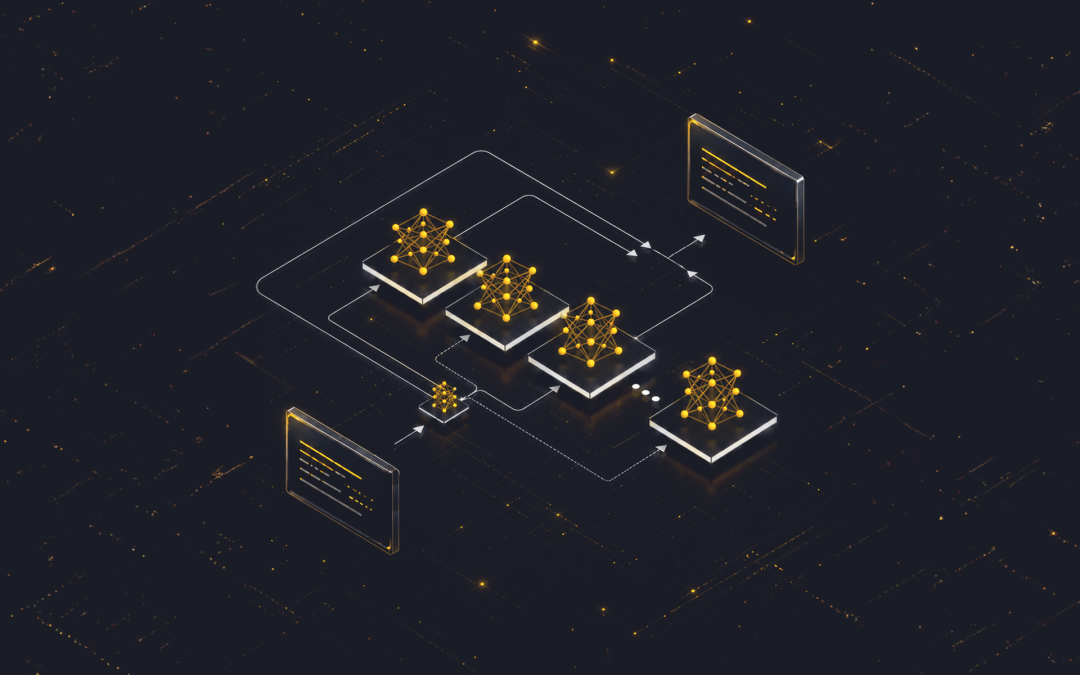
MoE models take a different approach. Here, a larger model is divided into specialized sub-networks called experts. Each expert develops its own area of focus during training, learning different internal patterns and representations based on the data routed to it. A small routing network decides which experts should handle each token and only that subset activates. The rest of the model sits idle for that step.
The result is larger model capability without requiring every parameter to be computed every time. Put another way, an MoE model can carry the knowledge and skills of a big model while activating only a fraction of its parameters for each token. This is ideal for local AI, where compute power may be limited.
Built for the way AI is used now
New MoE models show where this is heading. Take Google’s Gemma 4 26B A4B, for instance. According to Google’s documentation, the model carries 26 billion total parameters but activates only 4 billion per token, giving it a much lower per-token compute burden than a dense model of similar total size. Google positions it for consumer GPUs and workstations, with a built-in reasoning mode, a context window up to 256K tokens, image understanding, stronger coding performance, and native function calling (the ability to invoke outside tools and apps) to power autonomous agents.
In other words, capabilities that used to require a cloud API are now packaged for the desktop. And they map directly to what people actually want local AI to do: personal AI agents like OpenClaw and Hermes, coding assistants, private RAG over your own files, document analysis, research and planning tasks, and workflow automation.
There are many advantages to running these types of workloads locally. Your data stays on your hardware, which matters for privacy and compliance. Latency is predictable because nothing crosses the internet. There are no per-token API bills. And you stay in control of the model, the versions, and the stack.
The catch: MoE models aren’t smaller
It would be easy to assume that a model activating only 4 billion parameters needs only 4 billion parameters’ worth of memory. It doesn’t.
The model’s routing network chooses different experts for different tokens, so the full set of experts must be available at all times. Google’s own documentation makes this plain: while Gemma 4 26B A4B activates just 4 billion parameters per token, all 26 billion must be loaded into memory to keep routing and inference fast.
So, while MoE reduces active compute, it doesn’t shrink the memory footprint. In Phison’s tested configuration, running Gemma 4 26B A4B without any memory offload required roughly 23.5GB of system memory-easily beyond the capabilities of a 16GB system. As MoE models keep growing in capability, they will keep growing in size, exceeding the GPU and system memory of the local machines they were meant to empower.
With MoE, the new bottleneck for local AI is memory.

How Pascari aiDAPTIV™ helps MoE
Pascari aiDAPTIV™ is Phison’s AI memory management technology. It extends usable AI memory across three tiers: GPU memory, system DRAM, and NVMe SSD-based aiDAPTIV Cache Memory.
Its Dynamic MoE capability applies that architecture to Mixture of Experts models directly. Instead of requiring every expert to live permanently in GPU or system memory, aiDAPTIV treats experts as dynamically cached units. The experts the routing network needs are kept in GPU memory for computation, while the rest can be cached in system DRAM or offloaded to aiDAPTIV Cache Memory and loaded on demand as the model’s routing decisions change.
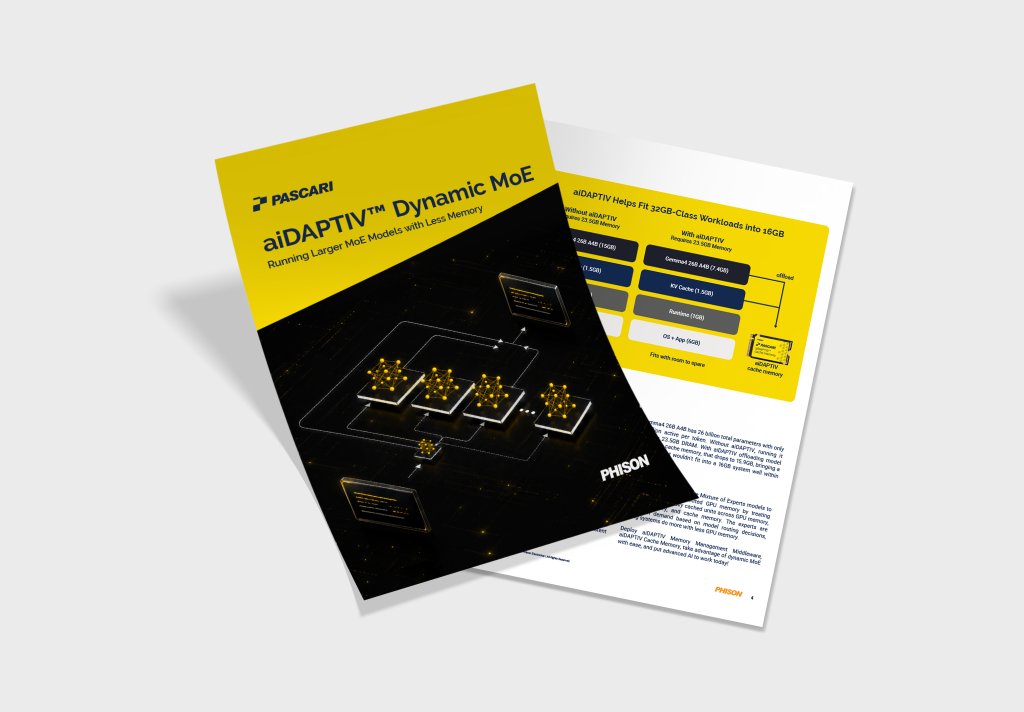
For example, running Gemma 4 26B A4B normally demands 23.GB of memory-15GB for model weights and 8.5GB for the KV cache, runtime, OS, and applications. With aiDAPTIV offloading a portion of the model to cache memory, system-memory use drops to 15.9GB. The offloaded experts now live on the SSD and are loaded only when the routing network calls for them. This brings a workload that wouldn’t fit on a 16GB system now within reach.
There’s an honest tradeoff to acknowledge, however. Moving experts between memory tiers can increase latency and reduce throughput. How much depends on the workload. Repetitive queries that reuse the same experts generally perform better, while tasks that jump between domains lean harder on the cache. However, for the workloads driving local AI today-agentic workflows, coding assistants, private RAG, document analysis, and research and planning tasks-what the model can do matters more than peak token speed. Phison’s aiDAPTIV technology makes the more capable model possible on the hardware you already have.
Go deeper: how Dynamic MoE actually works
This article covers what Dynamic MoE does. Our tech team developed a whitepaper that explains how it works and what to expect when you run it, including:
-
-
- How experts are placed across GPU memory, system DRAM, and cache memory, and how they move between tiers during inference
- What happens when the routing network calls for an expert that isn’t in GPU memory, and what that costs in latency
- How caching and eviction policies keep frequently used experts close to compute
- Which workload patterns perform best and what the tradeoffs are
-
Memory is the constraint that determines which models your system can run. The whitepaper spells out how much GPU memory, system DRAM, and SSD throughput each contribute so you can size a system for the model you want, not just the one that fits.
Ready to learn more?
Download aiDAPTIV Dynamic MoE: Running Larger MoE Models with Less Memory for a deeper look at MoE architecture, intelligent memory tiering, and how aiDAPTIV Dynamic MoE enables larger AI models to run on systems with limited GPU memory.
Frequently Asked Questions (FAQ) :
What is a Mixture of Experts (MoE) model?
A Mixture of Experts (MoE) model is a neural network architecture that activates only a small subset of specialized experts for each inference request, reducing computation while supporting much larger overall model capacity. Instead of processing every parameter for every token, MoE selectively routes workloads to the most relevant experts. This improves computational efficiency and enables larger AI models without requiring proportional increases in compute resources, although all experts must still remain accessible through the system’s memory architecture.
Why do Mixture of Experts models require so much memory?
Mixture of Experts models require substantial memory because every expert must remain available, even though only a few are active during each inference request. While compute requirements decrease because inactive experts are not executed, memory usage remains high since the entire collection of experts must be stored across the AI system. As model sizes increase, available memory often becomes the primary constraint on local AI deployment.
Is GPU memory more important than GPU compute for large AI models?
For many modern AI workloads, available memory has become just as important as GPU compute. Large language models frequently reach GPU memory limits before fully utilizing available processing power. As model architectures continue to expand, organizations increasingly need efficient memory utilization in addition to high-performance accelerators to deploy larger models successfully.
Can memory tiering help run larger AI models on existing hardware?
Yes. Memory tiering allows AI models to use GPU memory, system memory, and high-performance SSD-based cache memory together instead of relying exclusively on GPU memory. By dynamically placing active data in faster memory while relocating less frequently used data to lower tiers, organizations can execute larger AI models without immediately upgrading to higher-memory GPUs.
Should organizations buy larger GPUs or improve AI memory management?
Improving AI memory management often provides a more cost-effective way to scale local AI than purchasing increasingly larger GPUs. Higher-capacity GPUs remain valuable for many workloads, but intelligent memory architectures can significantly expand usable model capacity by making better use of existing GPU memory, system memory, and storage resources while balancing performance, scalability, and infrastructure costs.
How does Pascari aiDAPTIV™ improve Mixture of Experts deployments?
Pascari aiDAPTIV™ improves Mixture of Experts deployments by extending usable AI memory across GPU memory, system memory, and SSD-based cache memory while dynamically managing where experts reside during inference. Rather than requiring every expert to remain permanently loaded into GPU memory, aiDAPTIV moves inactive experts between memory tiers while keeping active experts readily available. This controller-aware memory architecture enables organizations to run larger AI models on existing infrastructure while maintaining efficient resource utilization.
Why is intelligent memory management becoming essential for enterprise AI?
Intelligent memory management is becoming essential because enterprise AI increasingly depends on memory efficiency rather than compute alone. As model sizes continue to grow, simply adding larger GPUs becomes more expensive and less practical. Solutions that dynamically coordinate GPU memory, system memory, and SSD-based cache help enterprises maximize existing hardware investments while supporting larger, more capable AI workloads with predictable performance.
How does Dynamic MoE differ from traditional GPU memory management?
Dynamic MoE differs from traditional GPU memory management by treating AI memory as a flexible hierarchy instead of requiring the full model to remain permanently resident in GPU memory. Pascari aiDAPTIV™ continuously evaluates which experts are actively needed and relocates inactive experts across memory tiers. This dynamic approach increases usable model capacity while balancing latency, memory efficiency, and inference performance.
Why is controller-level optimization important for AI memory architectures?
Controller-level optimization enables efficient movement of AI model data across GPU memory, system memory, and flash while minimizing bottlenecks that reduce inference efficiency. By coordinating firmware, storage controllers, and memory management, platforms such as Pascari aiDAPTIV can intelligently prioritize active model components, improve resource utilization, and support scalable AI deployments without relying solely on larger GPU memory footprints.
How does Pascari aiDAPTIV™ help organizations maximize existing AI infrastructure?
Pascari aiDAPTIV™ helps organizations maximize existing AI infrastructure by expanding usable AI memory through coordinated management of GPU memory, system memory, and SSD-based cache memory. This architecture enables larger Mixture of Experts models to operate on hardware that would otherwise be constrained by GPU memory capacity alone. The result is greater deployment flexibility, improved infrastructure efficiency, and a more scalable path for enterprise AI without requiring immediate investment in premium GPUs.





 English
  繁體中文
繁體中文  简体中文
简体中文  日本語
日本語  Deutsch
  한국어
한국어