
Find out why enterprise AI depends on pairing deep historical retention with high-speed data access, and how Pascari delivers both.
AI models and business intelligence (BI) platforms both depend on data, but the relationship is more complicated than simply having enough of it. A model trained on years of historical information can still produce sluggish, outdated insights if the storage behind it can’t deliver data fast enough for active use.
AI data retention and performance work as a pair rather than as separate concerns. Retention gives a model the depth it needs to recognize patterns and forecast accurately, while speed determines whether that depth can actually be put to work in time to matter. Many organizations focus heavily on one side of this equation while underinvesting in the other, which quietly limits what their AI and analytics systems can accomplish.
Why AI models depend on historical data depth
Model accuracy generally improves with exposure to more historical examples. A fraud detection system trained on a few months of transactions will miss seasonal patterns and rare edge cases that only appear over longer windows. A demand forecasting model needs multiple business cycles to distinguish a genuine trend from short-term noise. In both cases, the depth of the training set directly shapes how well the model generalizes to situations it hasn’t seen before.
This is where retention becomes a strategic asset rather than a compliance checkbox. Organizations that treat historical data as disposable, purging it once it ages past a certain point, end up retraining models on shallower datasets and accepting weaker performance as a result. The opposite approach, keeping years of data active and accessible, gives data science teams the raw material to build more sophisticated models over time.
The challenge is that historical datasets tend to be large, and large datasets are expensive to store on high-performance media. This tension pushes many organizations toward archiving older data on slower storage tiers, which solves the cost problem but creates a new one. If that historical data can’t be retrieved and processed efficiently, its value to active model training drops significantly, no matter how complete the archive is.
The role of real-time data in modern ML pipelines
While historical depth shapes a model’s foundational understanding, real-time analytics, meaning the ability to process and act on data as it arrives rather than after a delay, keeps that understanding current. Machine learning data pipelines increasingly blend both. A recommendation engine might rely on months of purchase history to establish baseline preferences, then layer in a customer’s activity from the last few minutes to refine that recommendation on the spot.
This blending places real demands on infrastructure. Streaming data has to be captured, processed, and made available to models with minimal delay, since even small lags can make recommendations, fraud alerts, or operational adjustments arrive too late to be useful.
Business intelligence platforms face a similar pressure. Executives increasingly expect dashboards that reflect what happened an hour ago, not what happened last week, which means the underlying data pipeline has to move at a pace that matches business decision cycles rather than traditional reporting schedules.
AI data access speed becomes the limiting factor here more often than raw compute power. A powerful model running on slow storage will still bottleneck at the point where it needs to read training data or retrieve features for inference. As pipelines mature and incorporate more real-time signals, the gap between compute capability and storage performance tends to widen unless architecture is deliberately designed to close it.
How siloed retention undermines performance
Many enterprises end up with retention and performance handled by entirely separate systems, often managed by different teams with different priorities. Archival storage gets optimized for cost per terabyte, while performance storage gets optimized for speed, with little coordination between the two. This siloed approach might look efficient on paper, but it creates friction exactly where AI and BI workloads need fluidity.
When historical data lives in a slow archive tier, pulling it into an active training pipeline requires a separate migration step, which adds delay and operational overhead every time a model needs retraining. Analysts querying across recent and historical data often hit the same wall, waiting for data to move between tiers before a query can even begin. Over time, this friction discourages teams from using historical data as often as they should, which quietly erodes the accuracy gains that deep retention was supposed to provide.
The deeper problem is that siloed retention treats storage as two unrelated decisions rather than one connected system. Retention strategy and performance strategy end up optimized independently, and the result rarely serves either AI accuracy or analytic responsiveness well. Closing this gap requires architecture that treats density and low latency as complementary design goals rather than competing budget lines.
Designing storage architecture for both density and low latency
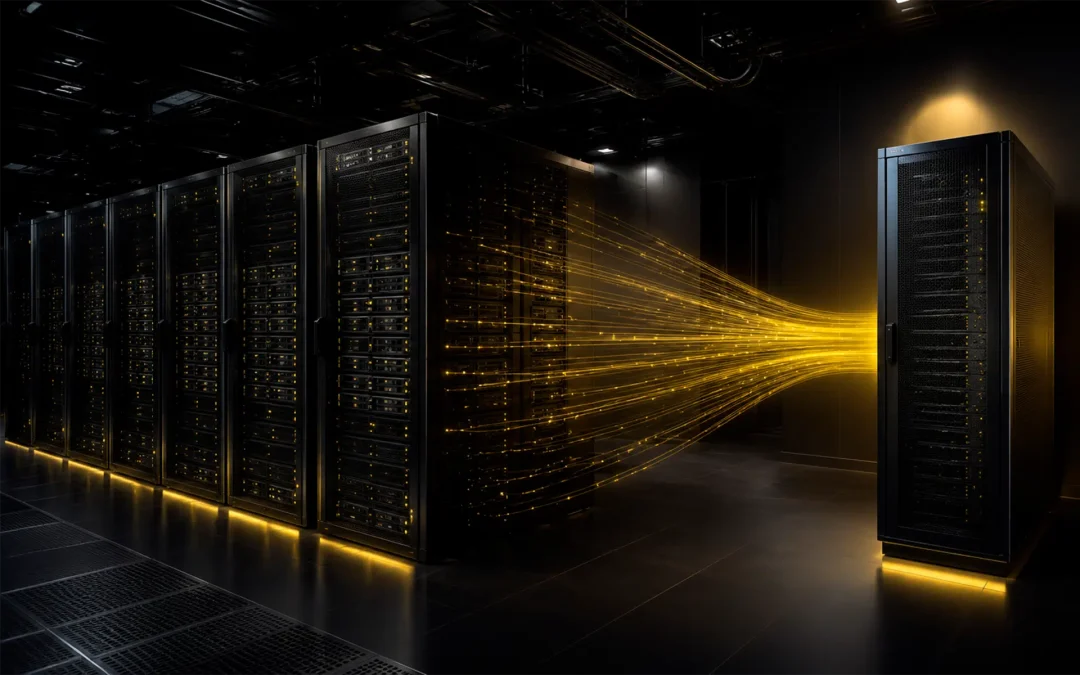
Enterprise AI storage architecture that supports modern workloads needs to deliver both retention depth and rapid access without forcing a tradeoff between them. This starts with choosing storage tiers deliberately rather than defaulting to whatever is cheapest for a given volume of data. Dense storage handles the sheer scale of historical datasets efficiently, while low-latency, high-performance SSDs, drives engineered to minimize the delay between a data request and its response, handle the retrieval and processing demands of active AI and BI workloads.
The goal is architecture where these tiers work together instead of operating as isolated systems. Data pipelines should be able to move information between dense retention layers and high-speed processing layers with minimal friction, so that a model retraining job or a real-time query doesn’t stall waiting for a manual migration. Throughput matters as much as latency in this context, since AI training often involves streaming large volumes of data continuously rather than making isolated requests.
High-speed AI storage designed with this balance in mind also supports better rack density, letting you scale both retention and performance within the same physical footprint rather than expanding two separate infrastructure tracks. This kind of integrated planning tends to produce more predictable costs and more consistent model performance than treating retention and speed as separate procurement decisions.
How Pascari enterprise SSDs work together in balanced AI infrastructure
Architectural principles only carry an organization so far without hardware built to support them, and the Pascari portfolio of enterprise SSDs was designed to close that gap between design and deployment.
For instance, the Pascari D206V addresses the retention side of this equation, offering up to 245.76 TB in a single U.2 drive at 0.3 DWPD—dense, read-intensive capacity suited to holding years of historical data without the cost burden of keeping everything on premium performance tiers. It gives you a practical way to preserve the depth that model training and long-term analytics depend on.
The Pascari X Series addresses the performance side, providing the low-latency retrieval that real-time analytics and active model training require. Where the Pascari D206V keeps historical datasets accessible at scale, Pascari X Series SSDs handle the active working set, data staged from those archives for training, along with fresh streaming data, fast enough to keep pace with inference and reporting demands.
Used together, these two product lines from Phison reflect the architectural balance modern organizations need. Retention and speed stop competing for the same budget and start reinforcing each other, with dense storage feeding depth into pipelines that high-speed storage can act on immediately.
Turn stored history into real-time advantage
AI models and business intelligence platforms succeed when they can draw on deep historical context and act on it without delay. Treating retention and performance as one connected system, rather than two separate infrastructure decisions, gives you the foundation to train more accurate models and deliver faster, more reliable insights. Balanced architecture, supported by Pascari enterprise SSDs, makes that foundation achievable without forcing a tradeoff between depth and speed.
Explore how Pascari enterprise SSDs enable balanced retention and high-speed AI and BI infrastructure. Or, contact a Pascari sales representative today.




 English
 繁體中文
 简体中文
 日本語
 Deutsch
 한국어