
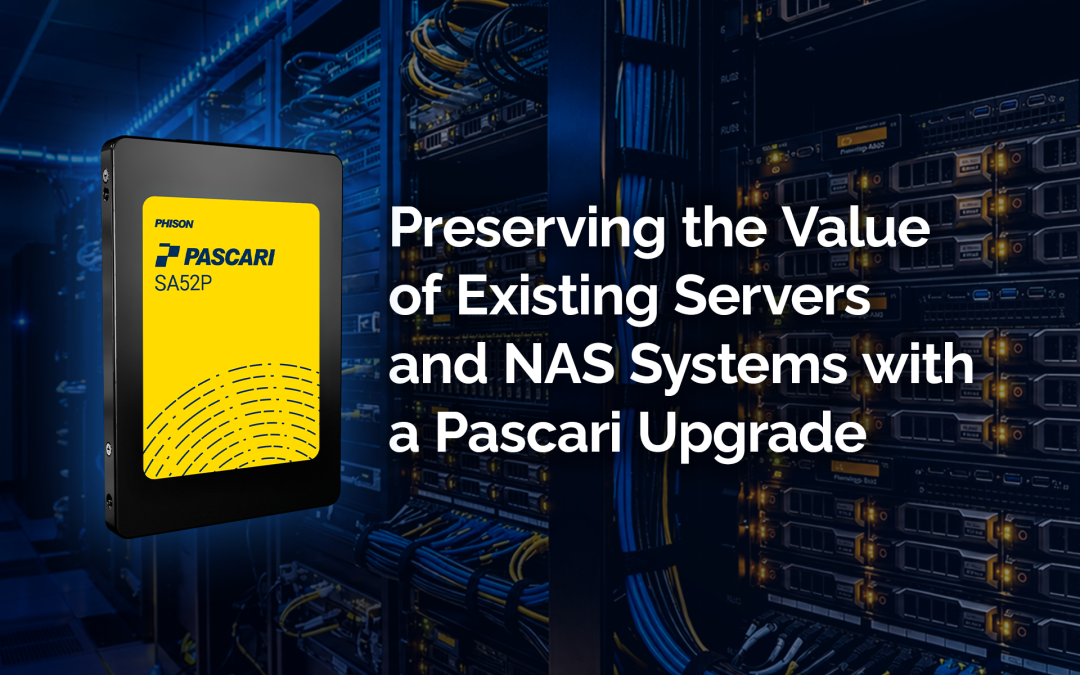
This smart approach to modernization reduces costs, improves efficiency, and helps you get more performance and longevity from the systems you already have.
Modern infrastructure strategy is often framed around what comes next. New platforms, new architectures, new investments. Yet across many organizations, there is a different reality sitting quietly in data centers and IT closets. Servers and NAS systems that are five or even 10 years old still power critical workloads. They are stable, familiar, and in many cases underutilized.
The challenge is that while compute needs may remain modest for workloads like file storage, backup, and archival, the storage layer underneath those systems has not kept pace. Aging hard drives introduce latency, increase failure risk, and limit overall system performance. Replacing entire systems is one option, but it is not always the most practical or cost-effective path.
A more strategic approach is emerging. Instead of starting from scratch, organizations are extending the life of what they already own. With the right upgrades, existing infrastructure can continue delivering value for years to come.
Why legacy infrastructure still matters
It is easy to assume that older systems are inherently obsolete. In reality, many servers and NAS platforms deployed over the past decade were built with enough compute headroom to handle today’s lower-intensity storage workloads. File sharing, backup repositories, and cold storage environments do not always demand cutting-edge processing power.
What they do require is dependable, responsive storage.
Over time, traditional hard disk drives become the limiting factor. Mechanical components wear down. Latency increases. Failure rates rise. Even when the system itself remains capable, the experience of using it begins to degrade.
This creates a gap between what the infrastructure could do and what it actually delivers. But closing that gap doesn’t have to mean a full replacement cycle. A targeted refresh could be just as effective.
Extending value instead of replacing it
There is a growing recognition across IT teams that infrastructure investments should be maximized, not rushed through replacement cycles. Budget constraints, supply chain challenges, and sustainability goals are all pushing organizations to think differently about how they manage hardware lifecycles.
Refurbishing existing servers and NAS systems offers a practical path forward. Many systems produced in the past five to 10 years still have meaningful usable life, especially for storage-focused workloads.
By upgrading key components rather than replacing entire systems, you can:
-
-
- Avoid the high capital expense of new infrastructure
- Reduce deployment complexity and downtime
- Maintain operational familiarity for IT teams
- Extend the return on existing investments
-
This approach also aligns with a broader shift toward more sustainable IT practices. Keeping hardware in use longer reduces electronic waste and lowers the environmental impact associated with manufacturing and disposal.
Of course, extending the life of infrastructure only works if performance and reliability improve in the process. And that’s where Phison and our Pascari SA52P enterprise SSD comes in.
The role of SSDs in modernizing legacy systems
Storage is often the most impactful upgrade you can make to an existing system. Moving from hard disk drives to solid-state storage transforms how data is accessed, processed, and delivered.
The Pascari SA52P is designed specifically for this kind of transition. It brings modern SSD performance and efficiency into environments that were originally built around HDDs.
The difference is immediately noticeable.
Sequential read speeds reach up to 530 MB/s, with write speeds up to 500 MB/s, delivering a significant improvement over traditional hard drives. Random performance also increases substantially, enabling faster access to small files and metadata-heavy workloads that are common in NAS and storage environments.
Latency drops as well, which has a ripple effect across the entire system. Applications respond faster. Backup windows shrink. Users experience less delay when accessing files.
While these improvements boost speed, they also directly impact how effectively your existing infrastructure can support modern workloads.
Supporting more with the same infrastructure
One of the less obvious benefits of upgrading to SSDs is the ability to handle more concurrent activity. As latency decreases and throughput increases, systems can serve more users, more applications, and more requests at the same time.
In practical terms, that means a single upgraded server or NAS device can take on additional responsibilities without requiring new hardware. It becomes possible to consolidate workloads, reduce sprawl, and simplify management.
This is particularly valuable in environments where storage demand continues to grow, even if compute requirements remain stable. Data is expanding rapidly across industries, and the systems that store that data need to keep up.
Upgrading storage allows legacy infrastructure to scale alongside that growth, rather than being sidelined by it.

Improving reliability where it matters most
Performance gains often get the spotlight, but reliability is just as important when extending the life of existing systems.
Older hard drives are more prone to failure simply due to wear and tear. Mechanical components degrade over time, increasing the likelihood of downtime and data loss. Replacing those drives with SSDs introduces a fundamentally different reliability profile.
The Pascari SA52P enterprise SSD is built with no moving parts, which eliminates many of the common failure points associated with HDDs. It is also designed with enterprise features that help protect data and maintain system integrity, including power loss protection, end-to-end data path protection, and encryption support.
In addition, the drives are rated for a 2 million hour mean time between failures and backed by a five-year limited warranty, providing confidence in long-term deployment.
For organizations relying on legacy systems to store critical data, this level of dependability is essential. The goal of extending infrastructure life is to reduce risk.
Driving efficiency across cost and energy
Extending the life of infrastructure is often driven by cost considerations, but the benefits go beyond avoiding new hardware purchases.
SSDs are significantly more energy-efficient than hard drives. The Pascari SA52P operates at just a few watts under load and even less when idle, which can lead to meaningful power savings across a fleet of systems.
Lower energy consumption translates into reduced operating costs and less heat generation, which can also ease cooling requirements in dense environments.
There are operational efficiencies as well. Faster performance reduces the time required for routine tasks like backups, data transfers, and system maintenance. IT teams spend less time managing bottlenecks and more time focusing on higher-value initiatives.
Taken together, these efficiencies reinforce the value of upgrading existing systems rather than replacing them outright.
A practical path forward for modern IT
Infrastructure decisions are rarely made in isolation. They are shaped by budget realities, operational demands, and long-term strategy. In today’s environment, flexibility is key.
The Pascari SA52P offers a practical way to modernize storage without disrupting everything else. It allows you to take a measured approach, upgrading what matters most while continuing to rely on proven systems.
This approach is especially relevant in a time when supply constraints and rising costs can make large-scale infrastructure refreshes difficult to justify. Extending the life of existing assets provides breathing room, both financially and operationally.
At the same time, it creates a foundation for future growth. Systems that perform better, run more efficiently, and operate more reliably are better positioned to support evolving workloads.
Rethinking what “new” really means
There is a tendency to equate innovation with replacement, especially when it comes to new technology, new hardware, and new environments. But in many cases, innovation comes from using what you already have in smarter ways.
Upgrading legacy servers and NAS systems with modern SSDs is a clear example of that mindset. It bridges the gap between past investments and present needs, unlocking performance and efficiency gains without starting over.
The Pascari SA52P is built for this moment. It delivers the performance, reliability, and efficiency needed to transform existing infrastructure into something that feels new again, while preserving the value that is already there.
For organizations looking to get more from their current environment, the path forward may not require a complete overhaul. Sometimes, it starts with a single upgrade that changes everything.
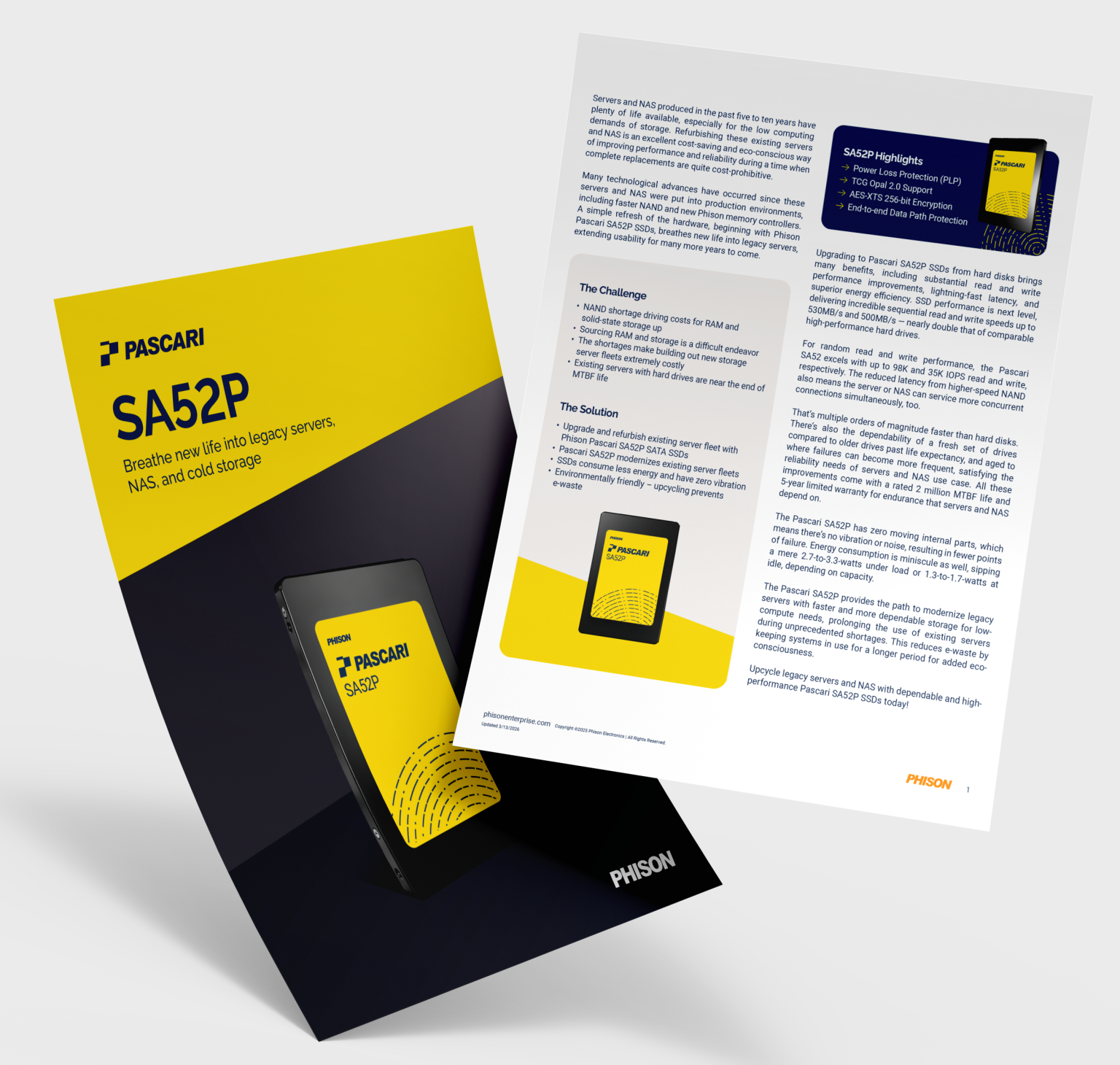
Learn more about how the Pascari SA52P enterprise SSD can enhance your existing infrastructure. Download the solution brief today.
Frequently Asked Questions (FAQ) :
Can older servers still support modern enterprise storage workloads?
Yes. Many servers and NAS platforms deployed within the last five to ten years still have sufficient CPU and memory resources for workloads such as backup, archival storage, departmental file sharing, and secondary storage environments.
In most cases, the performance limitation comes from aging HDD infrastructure rather than compute resources. Mechanical drives introduce higher latency, slower response times, and increased failure risk over time.
By upgrading the storage layer with enterprise SSDs, organizations can significantly improve throughput, reduce latency, and extend the operational life of existing systems without requiring a complete hardware refresh.
Why are HDDs becoming a bottleneck in legacy infrastructure?
Traditional hard drives rely on spinning platters and mechanical actuator arms, which inherently introduce latency and wear over time. As workloads continue generating larger datasets and more simultaneous requests, HDD-based systems struggle to keep pace.
This becomes especially noticeable in NAS environments, backup repositories, and metadata-heavy workloads where rapid file access is critical.
SSD-based storage eliminates these mechanical limitations, enabling faster sequential transfers, lower latency, and improved random access performance that modern workloads increasingly demand.
What are the financial benefits of upgrading storage instead of replacing entire systems?
A targeted storage upgrade can dramatically reduce capital expenditure compared to deploying entirely new infrastructure.
Organizations avoid costs associated with:
- New servers
- Infrastructure migration
- Downtime
- Rack reconfiguration
- Large-scale deployment projects
At the same time, SSD upgrades improve system responsiveness and operational efficiency while extending the usable lifespan of existing hardware investments.
This approach helps IT teams maximize ROI while maintaining flexibility for future modernization initiatives.
How do enterprise SSDs improve backup and archival environments?
Backup and archival workloads depend heavily on consistent storage responsiveness and reliability. Enterprise SSDs accelerate backup windows, improve restore speeds, and reduce bottlenecks during large data transfers.
Lower latency also improves concurrent access performance, allowing multiple backup operations or user requests to run more efficiently at the same time.
For organizations managing growing data volumes, SSD upgrades help existing backup infrastructure scale more effectively without requiring immediate platform replacement.
Is extending infrastructure lifespan considered a sustainable IT strategy?
Yes. Extending infrastructure lifespan aligns closely with sustainability initiatives focused on reducing electronic waste and minimizing unnecessary hardware replacement.
Many existing servers remain fully functional from a compute perspective. Replacing only the storage layer allows organizations to continue utilizing operational systems while improving performance and energy efficiency.
This strategy reduces environmental impact associated with manufacturing, shipping, and disposing of new hardware while supporting more responsible long-term infrastructure management.
What advantages does the Pascari SA52P provide for legacy system modernization?
The Pascari SA52P is engineered to modernize HDD-based enterprise infrastructure using a familiar SATA interface for broad compatibility.
Key capabilities include:
- Up to 530 MB/s sequential read performance
- Up to 500 MB/s sequential write speeds
- Low-latency access for metadata-intensive workloads
- Enterprise-grade endurance and reliability features
This enables organizations to modernize storage performance while preserving existing server and NAS investments.
How does the Pascari SA52P improve reliability compared to HDDs?
Unlike hard drives, the Pascari SA52P contains no moving mechanical components, eliminating common physical failure points associated with spinning media.
The drive also integrates enterprise-focused reliability technologies including:
- Power loss protection
- End-to-end data path protection
- Encryption support
- 2 million hour MTBF rating
These features help improve data integrity and reduce downtime risk in mission-critical enterprise storage environments.
Why is controller-level innovation important in enterprise SSD deployments?
Controller architecture directly impacts SSD reliability, latency management, endurance optimization, and workload consistency.
Phison’s controller-level innovation enables the Pascari SA52P to deliver stable enterprise performance while efficiently managing NAND behavior under sustained workloads.
This becomes particularly important in environments involving:
- Continuous backups
- NAS operations
- Multi-user file access
- Large-scale archival systems
Controller optimization helps maintain predictable low-latency storage performance over long deployment cycles.
How can the Pascari SA52P support AI-ready infrastructure strategies?
AI infrastructure growth is increasing pressure on storage systems across enterprises. Even environments not directly running AI workloads must manage larger datasets, backup volumes, and faster data access requirements.
The Pascari SA52P helps organizations improve storage responsiveness and scalability within existing infrastructure, allowing IT teams to allocate future budgets more strategically toward AI + ML readiness initiatives.
This creates a more balanced modernization strategy without forcing immediate full-scale infrastructure replacement.
Why are organizations adopting phased infrastructure modernization strategies?
Rising infrastructure costs, supply chain constraints, and operational complexity are pushing organizations toward incremental modernization approaches.
Rather than replacing entire environments at once, IT teams are prioritizing targeted upgrades that deliver immediate operational impact with lower disruption.
The Pascari SA52P supports this strategy by enabling organizations to modernize storage performance, improve efficiency, and extend infrastructure lifespan while maintaining operational continuity and reducing deployment risk.



 English
  繁體中文
繁體中文  简体中文
简体中文  日本語
日本語  Deutsch
  한국어
한국어