
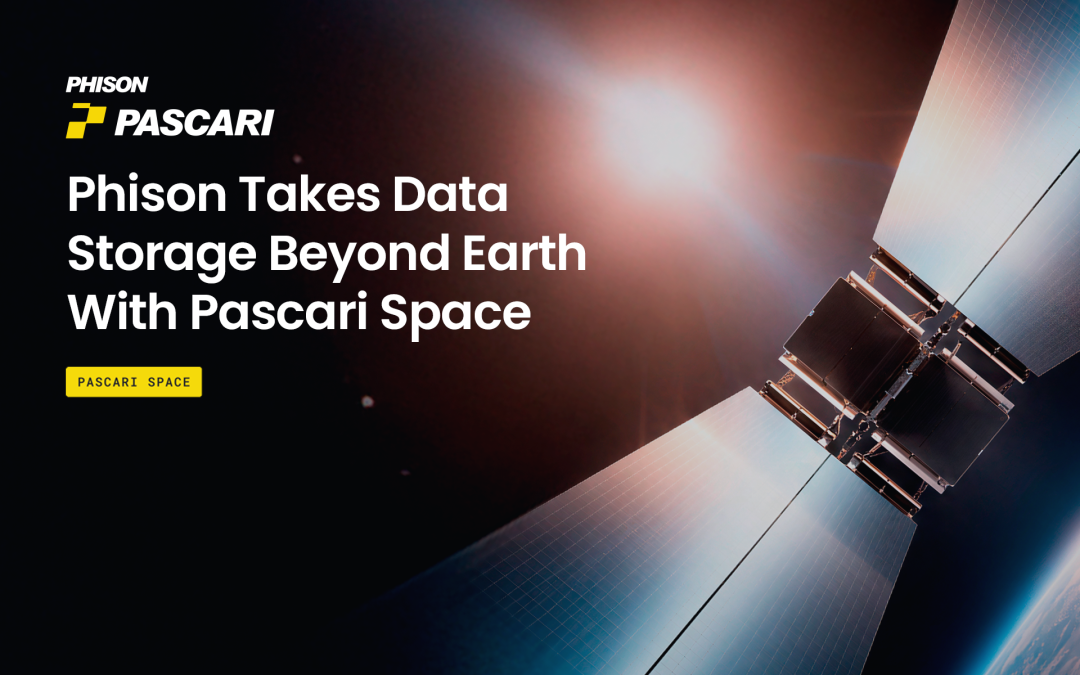
Fresh from its SC26 debut, Pascari Space brings mission-configurable SSDs to spacecraft, orbital data centers, and everything in between.
Space is getting busy. Satellites, research platforms, and even data centers are heading into orbit as launch costs fall and the space economy keeps growing. All of that hardware runs on data. And that data has to live somewhere.
That’s where things get hard. In orbit, storage faces radiation, wild temperature swings, and a launch that rattles every component on board. If a drive fails up there, nobody is coming to swap it out. What launches has to last the entire mission.
A new category built for the extreme
This week at Supercomputing 2026 (SC26) in Chicago, Phison launched Pascari Space, a new family of SSD solutions purpose-built for commercial space and orbital infrastructure.
Phison isn’t new to this. Pascari SSDs customized through the company’s IMAGIN+ design services have already achieved TRL-9 status, surviving launch, cislunar transit, and arrival on the lunar surface as part of a commercial lunar payload. That record was earned in flight. The same engineering now goes into every Pascari Space engagement.
Storage shaped around your mission
No two missions are alike. Orbit, radiation environment, and risk tolerance all vary, so a one-size-fits-all drive rarely makes sense. Pascari Space runs as a co-development program through Phison IMAGIN+ customization and design services. Phison designs its own controllers and firmware, which means mission teams can set endurance, retention, and error handling to match what the mission actually demands.
The portfolio includes three product lines. Together they cover everything from critical spacecraft systems to orbital data centers, and each one can be configured for a specific mission.
The next chapter of storage starts here
Orbital data centers. Spacecraft that think for themselves. Research missions that run longer and travel farther than ever before. None of it works without storage that can survive the trip or mission. Pascari Space opens the door to a new era of data in orbit, and this is only the beginning
Dive deeper into Pascari Space and the features and capabilities of Phison’s mission-specific SSD solutions in the press release. Or, explore Pascari Space on our website.
Frequently Asked Questions (FAQ) :
What is Pascari Space, and what applications does it support?
Pascari Space is a family of mission-configurable SSD solutions from Phison that addresses the storage requirements of commercial spacecraft, satellites, research platforms, and orbital data centers operating in environments with radiation exposure, extreme temperatures, and limited maintenance access. The portfolio includes three configurable product lines covering applications from critical spacecraft systems to orbital data infrastructure. Phison combines controller-level engineering, firmware customization, and mission-specific design services to align storage capabilities with operational requirements.
Why do spacecraft and satellites require specialized SSD storage?
Spacecraft and satellites require specialized SSD storage because radiation exposure, extreme temperature fluctuations, launch vibration, and limited maintenance opportunities create operating conditions that conventional storage designs may not adequately address. Mission planners must evaluate data retention, endurance, error handling, and operational longevity against the spacecraft’s expected environment and mission duration. Storage failure can compromise scientific data, onboard processing, or critical system functions, making mission-specific storage engineering essential.
What does TRL-9 mean for SSD technology used in space missions?
Technology Readiness Level 9 (TRL-9) indicates that a technology has demonstrated successful operation in an actual mission environment, providing stronger evidence of operational maturity than laboratory testing or simulated environmental qualification alone. Phison achieved TRL-9 with customized Pascari SSDs that completed launch, cislunar transit, and arrival on the lunar surface as part of a commercial lunar payload. This flight experience establishes a demonstrated foundation for Phison’s mission-specific storage engineering, although new configurations still require appropriate qualification.
How do space-grade SSD requirements differ from enterprise data center SSD requirements?
Space-grade SSD requirements place greater emphasis on environmental resilience, mission longevity, and data integrity under radiation, temperature extremes, and launch-related mechanical stress, while terrestrial enterprise SSD evaluations typically prioritize throughput, latency, endurance, capacity, and serviceability. Both environments require consistent storage behavior and effective error management. However, spacecraft introduce additional qualification challenges and limited opportunities for hardware replacement. Engineers must evaluate storage architectures against the specific environmental conditions, operational workloads, and failure risks of each deployment.
What should aerospace engineers evaluate when selecting SSDs for orbital data centers?
Aerospace engineers should evaluate SSD endurance, data retention, error-handling capabilities, environmental tolerance, and mission-specific qualification requirements when selecting storage for orbital data centers. The evaluation should account for radiation exposure, thermal conditions, launch stresses, expected workload intensity, and mission duration. Engineers should also assess how controller firmware manages data integrity throughout the deployment. Mission-configurable storage architectures provide greater flexibility to align SSD characteristics with orbital computing requirements than a standardized configuration alone.
How does Phison customize Pascari Space SSDs for different aerospace missions?
Phison customizes Pascari Space SSDs through its IMAGIN+ design services, combining in-house controller development and firmware engineering to align endurance, data retention, and error-handling behavior with specific aerospace mission requirements. The co-development approach allows mission teams to account for differences in orbital environments, operational duration, and acceptable risk. Rather than applying identical storage configurations across applications, Phison works with customers to define storage characteristics around the technical requirements of each deployment.
How does Phison's controller-level innovation support SSD performance and data integrity in space?
Phison’s controller-level innovation supports space-focused SSD engineering by enabling direct customization of firmware behavior, endurance management, data retention, and error handling for mission-specific operating conditions. Because Phison develops its own controllers and firmware, its engineering teams can coordinate hardware and software design decisions rather than relying entirely on fixed third-party controller implementations. This integration provides flexibility to address spacecraft storage requirements and develop configurations that align with mission reliability objectives.
How does Phison's lunar mission experience strengthen Pascari Space development?
Phison’s lunar mission experience provides Pascari Space with demonstrated flight heritage through customized Pascari SSDs that achieved TRL-9 after completing launch, cislunar transit, and arrival on the lunar surface. This experience establishes a practical engineering foundation for developing storage solutions for demanding aerospace environments. Phison applies the knowledge gained from that mission to Pascari Space engagements, helping customers evaluate storage configurations against environmental challenges, mission duration, and data integrity requirements.
How can Pascari Space support AI processing and autonomous computing in orbit?
Pascari Space can support onboard AI processing and autonomous computing by providing mission-configurable SSD storage for spacecraft and orbital infrastructure that must retain and access data throughout extended deployments. Autonomous systems and orbital computing applications require storage architectures that align with their data workloads, environmental conditions, and operational lifetimes. Through controller and firmware customization, Phison can help mission teams address endurance, retention, and error-handling requirements. Actual AI workload performance and latency characteristics require validation against the selected SSD configuration.
What advantages does Phison's co-development approach offer aerospace OEMs and orbital infrastructure providers?
Phison’s co-development approach gives aerospace OEMs and orbital infrastructure providers the flexibility to configure SSD endurance, data retention, and error-handling capabilities around individual mission requirements rather than adopting a fixed storage architecture. Through IMAGIN+ design services, Phison integrates controller engineering and firmware customization into the development process. This approach supports mission-specific design decisions across spacecraft systems, scientific payloads, and orbital data centers while helping engineering teams align storage characteristics with deployment conditions and operational objectives.





 English
 繁體中文
 简体中文
 日本語
 Deutsch
 한국어