
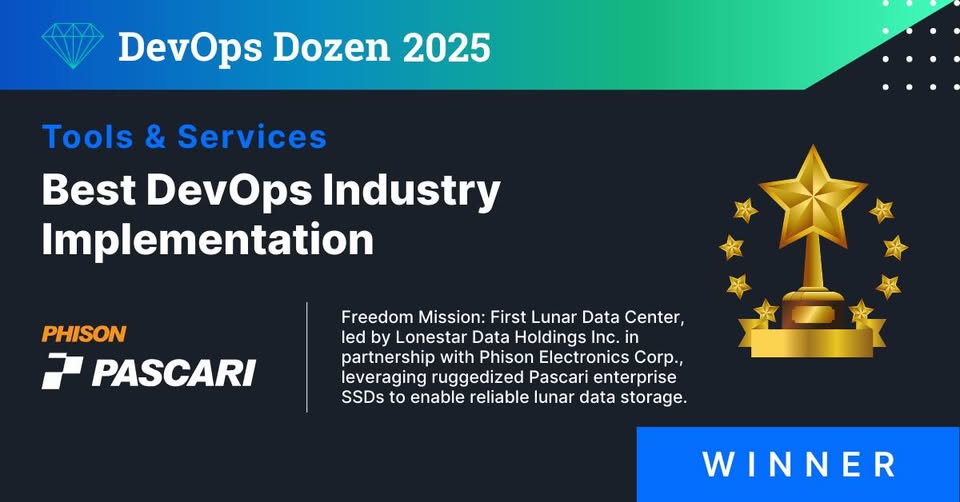
Awarded Best DevOps Industry Implementation by the DevOps Dozen, this milestone deployment reveals what DevOps looks like when hardware, firmware, and validation are engineered as one.
When people talk about DevOps success, the conversation often stays grounded in software. Continuous integration pipelines, automated testing, cloud-native platforms, and rapid iteration dominate most case studies. That framing makes sense for many environments, but it breaks down when systems are deployed far beyond the reach of data centers, technicians, or even Earth itself.
In early 2025, Lonestar Data Holdings and Phison challenged that assumption. By placing the world’s first hardware-based data center on the moon, the game-changing Freedom Mission demonstrated that DevOps principles extend well beyond code and cloud services. Success depended on tight integration across hardware, firmware, validation, and deployment, all engineered as a single lifecycle. And Phison’s role as the storage and controller partner was central to making that vision possible.
This achievement recently earned industry recognition through the DevOps Dozen Award for Best DevOps Industry Implementation, validating the technical rigor behind one of the most ambitious DevOps deployments ever attempted.
Why the Freedom Mission matters
The Freedom Mission was designed to prove that data infrastructure can operate reliably in space. Rather than sending raw data back to Earth for processing and storage, the mission established a lunar-based data center capable of securely storing information and transmitting it back when needed. This approach reflects a growing interest in edge computing infrastructure, where data is processed closer to where it is generated, even in environments that push the limits of engineering.
Operating a data center on the Moon introduces constraints that do not exist in terrestrial deployments. Systems must withstand extreme temperature swings, vacuum conditions, radiation exposure, launch vibration, and long periods without physical access. There is no opportunity for field repairs, component swaps, or manual intervention. Every element must function exactly as designed, from the moment of launch through lunar operations.
The mission succeeded in validating data storage and Earth transfer during its lunar deployment. That success was not the result of a single breakthrough, but of coordinated engineering across multiple layers of the technology stack.
DevOps beyond software
Traditional DevOps models often focus on software delivery speed and reliability. In the Freedom Mission, those principles were applied to a much broader scope. Hardware design, firmware development, testing, and deployment were treated as part of the same continuous lifecycle.
For a lunar deployment, the feedback loops that power DevOps practices look different. Engineers cannot patch systems in real time or respond instantly to unexpected conditions. Instead, reliability is built upstream through extensive validation and cross-disciplinary collaboration. Hardware and firmware must be designed together, tested together, and validated under conditions that closely simulate the final operating environment.
This approach reflects a more complete view of DevOps implementation success. Rather than separating infrastructure from software workflows, the Freedom Mission treated storage, controllers, firmware optimization, and system integration as inseparable components of the delivery pipeline.

Engineering data storage for the lunar environment
Phison served as the storage and controller partner for the Freedom Mission, working closely with Lonestar Data Holdings to design, customize, and validate the storage layer of the lunar data center. This role went far beyond supplying off-the-shelf components.
The lunar environment presents a unique combination of challenges that push conventional enterprise data storage hardware beyond its typical operating envelope. Storage devices must operate without atmospheric pressure, handle intense radiation exposure, and function across wide temperature ranges. Power availability is limited, making efficiency as important as performance.
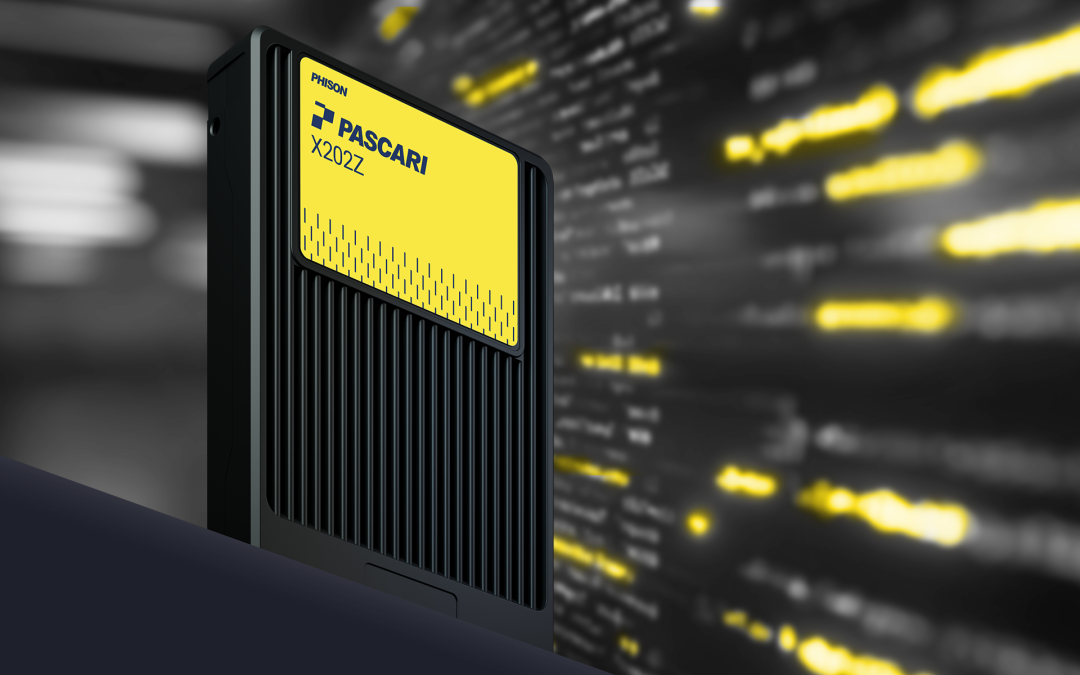
Phison engineers addressed these challenges at multiple levels. The company’s Pascari Enterprise SSDs provided the enterprise storage foundation, while Phison’s controller and firmware expertise enabled deep customization tailored to lunar conditions.
Firmware was tuned to balance performance with strict power budgets and long-term reliability requirements. Controller-level optimizations supported predictable behavior under radiation exposure and minimized risk during extended operation without maintenance. Validation processes subjected the storage systems to vacuum conditions, vibration testing, and extreme temperature scenarios to ensure predictable behavior once deployed. These steps were not treated as isolated tests, but as part of an integrated validation lifecycle aligned with DevOps principles.
This level of customization highlights a broader capability that Phison brings to advanced deployments. By controlling both the hardware and firmware layers, Phison can adapt enterprise storage platforms for specialized use cases, using its IMAGIN+ services, where standard configurations fall short. In the context of the Freedom Mission, that adaptability was essential.
The result was a storage platform capable of supporting continuous data operations in one of the most unforgiving environments imaginable.
DevOps Dozen award recognizes Freedom Mission’s value
The DevOps Dozen Awards, and its Best DevOps Industry Innovation category, honor organizations that demonstrate real-world DevOps success at scale. In this case, the award validated a deployment that extended DevOps principles beyond conventional boundaries.
Judges recognized the Freedom Mission as the first hardware-based lunar data center and highlighted the integration required to make it work. Hardware engineering, firmware development, validation, and deployment were aligned as a single operational pipeline. Each phase informed the next, reducing risk and increasing confidence in the final system.
This recognition underscores an important point for DevOps leaders and platform engineers. DevOps maturity is not defined solely by software velocity or cloud adoption. It is defined by the ability to deliver reliable systems through integrated workflows, even when conditions are extreme and margins for error are minimal.

What this means for future edge deployments
The success of the Freedom Mission has implications that extend well beyond space. As organizations push compute and storage closer to the edge, environments will become more diverse and less forgiving. Remote industrial sites, autonomous systems, and sovereign infrastructure all introduce constraints that resemble those faced in lunar deployment.
In these scenarios, DevOps implementation success will depend on the same principles demonstrated by the Freedom Mission. Hardware, firmware, and software must be engineered together. Validation must reflect real operating conditions. Customization must support resilience rather than complexity.
Phison’s work on the Freedom Mission shows how enterprise storage platforms like Pascari SSDs can be adapted to meet these demands. Through deep engineering partnerships and lifecycle integration, DevOps practices can support deployments that operate far beyond traditional data centers.
Explore the award-winning Freedom Mission and see the full DevOps Dozen slate of winners to learn more about how DevOps continues to evolve at the edge of innovation.

Frequently Asked Questions (FAQ) :
What is the Freedom Mission and why is it significant?
The Freedom Mission is the first deployment of a hardware-based data center on the Moon. It proves that data storage and transmission can operate reliably in extreme, remote environments without human intervention. This shifts infrastructure design toward true edge computing, where data is processed closer to its origin rather than relying on Earth-based systems.
How does DevOps apply to hardware systems like this mission?
In this deployment, DevOps extends beyond software pipelines. Hardware design, firmware development, and validation are integrated into a continuous lifecycle. Engineers treat storage systems, controllers, and firmware as a unified delivery pipeline, ensuring reliability before deployment since post-launch fixes are not possible.
What challenges do data centers face in space?
Space environments introduce radiation exposure, vacuum conditions, extreme temperature fluctuations, and zero maintenance access. Systems must be fully validated before launch, with no reliance on real-time troubleshooting or physical repair.
What is edge computing and how does this mission relate?
Edge computing processes data closer to where it is generated. The lunar data center represents an extreme-edge use case, where data is stored and managed off-Earth, reducing dependency on terrestrial infrastructure and improving resilience.
Why did the mission receive the DevOps Dozen Award?
The award recognizes the integration of hardware, firmware, and validation into a single DevOps pipeline. Judges highlighted the mission’s ability to deliver a fully operational system in one of the most challenging environments ever attempted.
How did Phison contribute to the lunar data center deployment?
Phison delivered customized enterprise SSDs, controller architecture, and firmware optimization. The company engineered the storage stack to meet strict power, endurance, and reliability requirements under lunar conditions.
What makes Phison’s controller-level innovation critical for extreme environments?
Phison designs both controllers and firmware, enabling deep optimization at the silicon level. This allows precise control over latency, power consumption, and error handling, which are critical for deployments where system failure is not recoverable.
How were Phison SSDs validated for space deployment?
Validation included vacuum testing, radiation tolerance considerations, vibration stress testing, and thermal cycling. These processes simulate real operating conditions to ensure predictable performance throughout the mission lifecycle.
How does this project demonstrate Phison’s enterprise storage capabilities?
The mission highlights Phison’s ability to co-design hardware and firmware for specialized use cases. Through IMAGIN+ services, Phison adapts enterprise SSD platforms for environments where standard configurations cannot meet reliability or performance requirements.
What does this mean for future enterprise and AI infrastructure?
As AI and edge workloads expand, infrastructure must operate in diverse and constrained environments. Phison’s approach, including low-latency storage, power-efficient controllers, and integrated validation, positions its solutions for AI-ready, distributed deployments across hyperscale, edge, and extreme conditions.




 English
  繁體中文
繁體中文  简体中文
简体中文  日本語
日本語  Deutsch
  한국어
한국어