
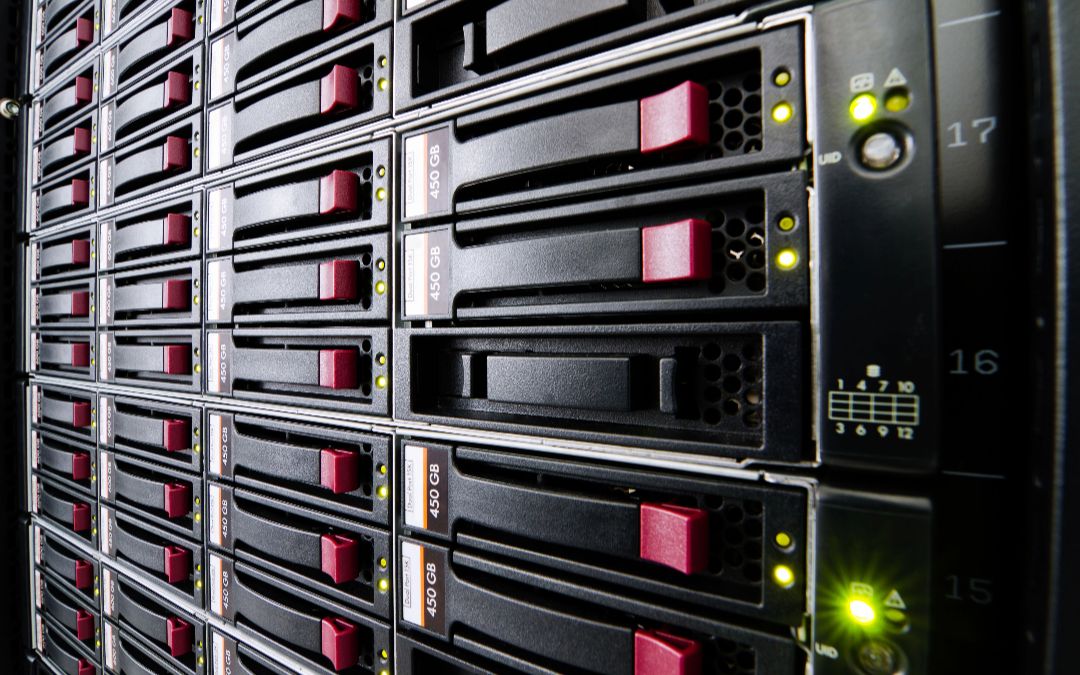
Opinions on the matter vary, but today’s trends and technologies are boosting SSD adoption.
In the data storage world, there’s an ongoing debate about SSDs versus HDDs and whether the HDD is becoming obsolete. It’s been a topic of conversation for years, maybe even since the mid-1990s, which is when SSDs emerged onto the scene. Even now, a new development in SSDs or HDDs can occasionally sway opinions one way or the other.
The latest industry buzz provides a boost for those in the SSD camp. According to an article from Blocks and Files, “Maximum SSD capacity is expected to double from its current 61.44 TB maximum by mid-2025, giving us 122 TB and even 128 TB drives, with the prospect of exabyte-capacity racks.”
While doubling SSD capacity is exciting news, most experts believe SSDs have a long way to go before they completely replace HDDs (if ever). A recent IEEE study reported that “SSDs and HDDs continue to coexist because HDDs (and tape) will continue to offer the lowest cost per bit for the foreseeable future.”
For performance-dependent workloads, SSD use is certainly climbing as enterprises and other industries move to flash-based storage. Those critical workloads are worth the investment in the highest-performance drives. When it comes to bulk mass storage, however, price still reigns supreme. The IEEE stated that “the ultra-high capacity HDD market will remain unavailable to flash for the foreseeable future due to its lower cost per bit.”
It’s difficult to say how the potential rise of SSDs and decline of HDDs will play out in the next decade or two—but one thing is clear. SSDs are indeed becoming ever more critical to modern computing, whether they’re used to power a gaming laptop, running enterprise applications on-premises or clustered into hundreds of thousands of nodes in a hyperscaler data center. And they will likely continue that trend to become the de facto data storage of choice at some point. When that point will be is the real question.

Trends show SSD growth and changes ahead
The performance benefits of SSDs over HDDs are uncontested. SSDs are simply faster and offer much better transfer rates, IOPS and latency. Since the emergence of SSDs, price has been a primary obstacle, as HDDs were orders of magnitude cheaper. Existing infrastructure was also an issue because all of the IT hardware was originally designed for HDDs and the first SSDs plugged into that hardware were limited in serious ways.
Over the years, things have changed significantly. Both SSD performance and capacity have increased and prices have decreased. Hardware manufacturers began designing storage chassis specifically for SSDs or at least to accommodate SSDs better. Technologies such as PCIe, Compute Express Link (CXL) and NVMe over Fabric (NVMe-oF) made it easier to get the best performance out of SSDs.
In 2020, the industry reached a milestone of sorts, according to Sebastien Jean, Phison CTO. In an interview with Chris Evans for the Storage Unpacked podcast, he said, “That was the first year where … there were more SSDs produced than HDDs. That was the tipping point for economies of scale.”
Today, the HDD market has moved away from performance, said Jean. Workloads that require high performance typically use SSD data storage. HDDs still dominate when it comes to capacity, though, making capacity a real focus for many SSD manufacturers.
Factors that will continue to drive SSD adoption in the near future
The following are some trends and technologies that will drive more enterprises to deploy SSDs over HDDs.
Real-time analytics
As enterprises become more data-focused, they will increasingly rely on real-time data analytics platforms to process enormous volumes of data from a wide range of sources. They need data storage that is super-fast with low latency to extract the most value out of their data assets.
Low-latency applications
The more consumers go online to bank, shop, trade stocks and so on, the more organizations will need high-performance data storage for applications that are time-sensitive to milliseconds and beyond.
AI and machine learning
Because AI models require very large amounts of data, fast and responsive data storage is a must for ingestion, data cleaning, exploration, training and deployment.
Higher-density SSDs
To increase capacity, SSD manufacturers are increasing the number of NAND levels on a drive. That means they can store more data. SSDs are available with single-level cell (SLC), multi-level cell (MLC), triple-level cell (TLC) and quad-level cell (QLC). As NAND levels increase, capacity goes up and price goes down. QLC SSDs became available about six years ago and they provide the most capacity at lower prices. Some manufacturers have even talked about penta-level cell (PLC) SSDs, but they’re not available yet.
5G and Internet of Things
As 5G networks grow and enable millions more IoT devices, the need for fast, reliable data storage is driving users to high-performance SSDs. Small SSD sizes are also a benefit, especially for IoT devices, which can often be very compact—such as surveillance cameras, vibration sensors and so on .
Sustainability and energy consumption regulations
Green computing and energy-use mandates are driving enterprises to adopt SSDs, thanks to their low power consumption. SSDs use less power in a data center and reduce the physical footprint of a data center, which also means less need for cooling and ventilation.
Cloud and edge integration
Many enterprises are turning to SSDs that integrate with the cloud and edge devices. Drives optimized for cloud and the edge deliver low-latency access to data and fast data transfer.

Phison enables enterprises to embrace advanced applications
With Phison SSDs and data storage solutions, enterprises have the fast, reliable data storage they need to make the most of their valuable data. At CES 2024, the company announced its 128 TB X200 QLC SSD, due later this year. It also debuted the robust Phison D200V with 122.88 TB at the Future of Memory and Storage event in August. The Gen5 D200V can “store the data that would require ten HDDs.”
Whether they’re training AI algorithms, going green in the data center, leveraging the edge or analyzing vast stores of data in real time, Phison empowers enterprises to innovate faster and gain a competitive edge.
Frequently Asked Questions (FAQ):
Will HDDs become obsolete in enterprise environments?
HDDs are unlikely to become fully obsolete in the near term. While SSD adoption continues to accelerate, HDDs still deliver the lowest cost per bit for bulk, cold, and archival storage. Industry consensus, including IEEE research, indicates long-term coexistence, with SSDs dominating performance-critical workloads and HDDs remaining relevant for ultra-high-capacity storage.
Why are enterprises shifting workloads from HDDs to SSDs?
Enterprises are prioritizing SSDs due to lower latency, higher IOPS, and faster throughput. Modern workloads such as real-time analytics, transactional platforms, AI training, and latency-sensitive applications require performance levels that HDDs cannot deliver consistently.
What workloads benefit most from SSD adoption?
SSD adoption is strongest in:
- Real-time analytics and databases
- AI and machine learning pipelines
- Low-latency financial and e-commerce systems
- Cloud, edge, and hyperscale infrastructure
These workloads depend on predictable performance and fast data access.
Why does HDD still dominate bulk storage?
HDDs continue to offer a significantly lower cost per terabyte, making them suitable for cold data, backups, and long-term archives. Flash storage has not yet matched HDD economics at extreme capacity tiers, particularly for data that is infrequently accessed.
How have SSD technologies evolved to enable wider adoption?
Advances in NAND density, NVMe, PCIe Gen5, NVMe-oF, and CXL have removed historical bottlenecks. Higher-density NAND (TLC and QLC) has lowered cost per bit, while new interfaces unlock full controller-level performance.
How does AI accelerate SSD adoption?
AI workflows require fast ingestion, iterative training, and rapid model deployment. SSDs reduce pipeline bottlenecks by delivering consistent low latency and high throughput, enabling faster training cycles and more efficient GPU utilization.
What role does QLC NAND play in replacing HDDs?
QLC SSDs increase storage density while reducing cost per terabyte, positioning flash as a viable alternative for read-heavy and mixed workloads. High-capacity QLC drives are narrowing the gap between performance storage and capacity storage tiers.
How does Phison address enterprise storage demands?
Phison designs controller-level SSD solutions engineered for enterprise and hyperscale environments. These solutions focus on endurance optimization, predictable latency, firmware customization, and workload-specific tuning rather than generic flash performance.
What enterprise SSD solutions has Phison introduced recently?
Phison has announced high-capacity enterprise QLC SSDs, including the Phison X200 and Phison D200V. These drives deliver HDD-scale capacity with flash-level performance and density, reducing rack footprint and power consumption.
When might SSDs become the default enterprise storage medium?
SSDs are already the default for performance-critical workloads. As flash density increases and cost per bit continues to decline, SSDs are expected to expand into capacity-oriented tiers. The timing depends on economics, but long-term momentum clearly favors flash-based architectures.




 English
  繁體中文
繁體中文  简体中文
简体中文  日本語
日本語  Deutsch
  한국어
한국어