
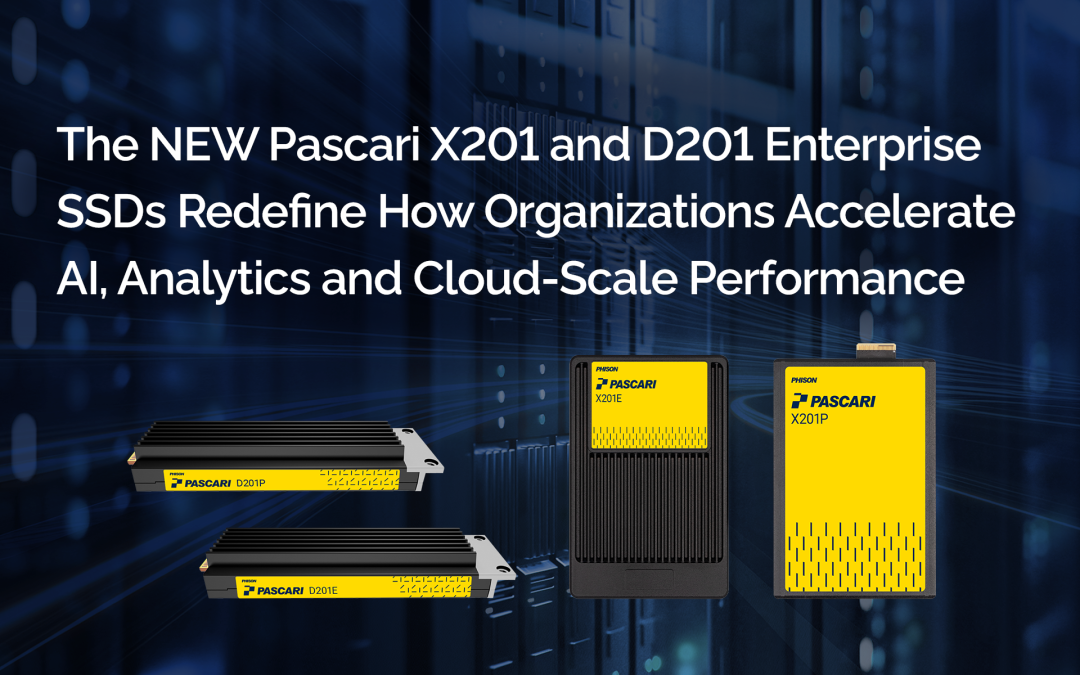
Enterprises are redefining what “fast” and “efficient” mean in a world of AI, real-time analytics and cloud-native applications. To stay ahead, infrastructure has to balance raw performance with scalable efficiency.
That’s where Phison’s Pascari X201 and D201 drives come in. They’re helping organizations move data faster, store more intelligently and deliver the performance edge modern workloads demand. In this article, we’ll take a closer look at where and how these drives can make the biggest impact.
Pascari X201: Accelerating insight at AI speed
The Pascari X201 is built for organizations that live on the bleeding edge of performance, where every microsecond counts and every workload is a race against data gravity.
AI model training
In AI labs and data centers, model training workloads depend on steady streams of data moving between GPUs and storage. The Pascari X201 offers up to 14.5 GB/s sequential read, up to 12 GB/s write and up to 3300K/1050 IOPS, which enable data scientists to feed training datasets into GPU clusters without bottlenecks. That means faster epoch times, shorter training cycles and more frequent model iterations, accelerating everything from computer vision and natural language models to autonomous systems development.
Large-scale analytics
For enterprises running real-time analytics or complex simulations, the Pascari X201’s low-latency PCIe Gen5 architecture ensures instantaneous access to massive datasets. In financial services, that translates to faster risk modeling and fraud detection; in healthcare and research, it means near-real-time insights from genomic data or patient telemetry streams.
High-frequency trading (HFT)
In trading environments, nanoseconds can determine profit or loss. With its predictable quality of service (QoS) and endurance options up to 3 DWPD, the Pascari X201 sustains performance under constant read/write cycles. This makes it ideal for market data capture, algorithmic trading engines and time-sensitive analytics where speed, reliability and consistency directly impact outcomes.
Other examples of applications or workloads that rely on ultra-low latency, extreme IOPS and sustained throughput include:
-
-
- AI and data science – AI inference at scale for recommendation engines or autonomous systems; generative AI or retrieval-augmented generation (RAG) pipelines using vector databases and embeddings; and simulation or digital twin modeling requiring continuous high-speed writes
- Financial services – high-frequency trading and algorithmic strategies; risk analysis/fraud detection with real-time scoring; market-data ingestion and/or replay with near-zero latency
- Scientific and research computing – genomics and bioinformatics pipelines; weather and climate modeling; physics and astronomy high-performance computing (HPC) simulations
- Media and entertainment – 4K/8K video editing and real-time post-production; visual-effects rendering farms; virtual production stages tied to GPU render nodes
- Enterprise/industrial – real-time analytics and ERP/SAP HANA transactional systems; cybersecurity and threat detection platforms with high ingest and query rates
-
From AI labs to enterprise analytics clusters, the Pascari X201 delivers performance that doesn’t just keep up with next-generation workloads, it fuels them.
Pascari D201: Scaling the cloud without compromise
Where the Pascari X201 is all about velocity, the Pascari D201 is about scale and storing, serving and managing massive volumes of data efficiently across hyperscale and cloud environments.
Object storage at scale
Modern cloud applications rely on object storage for durability and elasticity. The Pascari D201’s 15.36 TB capacity per drive in a compact E1.S 15mm form factor allows cloud operators to consolidate storage nodes and reduce rack footprint without sacrificing throughput. That efficiency translates directly into lower total cost of ownership (TCO) and simplified capacity expansion for services handling petabytes of user data, backups or AI datasets.
Database clusters
In distributed database systems, from NoSQL clusters to massive SQL data warehouses, consistency and endurance are key. With Gen5 performance up to 14.5 GB/s read and up to 12 GB/s write, plus endurance options of 1 or 3 DWPD, the D201 handles mixed read/write workloads with ease. Enterprises can maintain predictable response times for millions of transactions, even as their data grows exponentially.
Content delivery networks (CDNs)
For CDNs powering video streaming, gaming and global web services, the Pascari D201 offers a balance of density and throughput that keeps content flowing without latency. Its power efficiency ensures minimal cooling and energy overhead, supporting sustainable infrastructure strategies while delivering peak user experience across continents.
Other examples of applications or workloads that prioritize density, efficiency and predictable QoS across large deployments include:
-
-
- Cloud service providers and hyperscalers – object storage for backups, media repositories or AI training data lakes; database clusters (SQL, NoSQL, or time-series) that need consistent throughput; multi-tenant infrastructure as a service (IaaS) and platform as a service (PaaS) with thousands of virtual machines or containers
- Edge and IoT – edge AI inference nodes needing compact, efficient high-capacity drives; real-time IoT analytics and sensor data aggregation
- Enterprise infrastructure – virtual desktop infrastructure (VDI) supporting fast boot storms; data center consolidation to shrink rack footprint and power draw; blockchain nodes where sustained write endurance meets density
- Scientific and media archival – long-term research data repositories; media asset archives requiring fast retrieval and minimal latency
-
In every scenario, the Pascari D201 proves that capacity and efficiency aren’t trade-offs, they’re accelerators for growth.

Performance that scales with possibility
Together, the Pascari X201 and D201 demonstrate how Phison continues to meet the evolving demands of modern data infrastructure, uniting speed, capacity and reliability to help organizations innovate faster and scale smarter.
Whether training tomorrow’s AI, analyzing petabyte-scale data or powering global cloud platforms, Phison’s latest enterprise SSDs are designed to keep you ready for whatever’s next.
Frequently Asked Questions (FAQ) :
What workloads benefit most from the Pascari X201?
The Pascari X201 is engineered for high-velocity, low-latency environments where data throughput dictates compute efficiency. AI model training, real-time analytics, HFT engines, large-scale simulations, and GPU-accelerated pipelines benefit significantly. With up to 14.5 GB/s read, 12 GB/s write, and up to 3,300K / 1,050K IOPS, it feeds GPU clusters without bottlenecks, supporting faster epoch cycles, reduced compute idle time, and predictable QoS for latency-sensitive tasks.
How does PCIe Gen5 improve AI training and inference performance?
PCIe Gen5 doubles bandwidth compared to Gen4, allowing GPUs, vector databases, RAG pipelines, and simulation frameworks to ingest and stream data continuously. The X201 and D201 sustain Gen5 throughput at scale, preventing queue backlogs. For inference workloads—such as recommendation engines or real-time decision systems—this means lower inference latency and higher request concurrency without performance degradation.
Why is low latency crucial for large-scale analytics and financial modeling?
Analytics clusters ingest terabytes of telemetry, logs, or transactional data. In financial services, milliseconds impact risk scoring, fraud detection, and liquidity analysis. The X201’s ultra-low latency, high IOPS profile ensures immediate random access to distributed datasets, supporting sub-second analysis cycles and stable response times under pressure. This improves both decision accuracy and computational efficiency.
What makes the Pascari D201 suitable for cloud and hyperscale environments?
The D201 combines Gen5 throughput with 15.36 TB density in the compact E1.S 15mm form factor, enabling cloud operators to consolidate nodes, reduce rack footprint, and increase storage per RU. Its predictable QoS, 1–3 DWPD endurance, and power-efficient architecture align with hyperscale requirements for multi-tenant storage, object stores, backup tiers, CDN infrastructure, and large database clusters.
How do enterprises decide between using the X201 vs. the D201?
Use the X201 when workloads require maximum IOPS, minimal latency, and sustained throughput, such as AI training labs, HFT systems, simulation clusters, and GPU-accelerated inference pipelines.
Choose the D201 for capacity-optimized deployments at cloud, CDN, or archival scale—where density, predictable QoS, and cost-efficient scaling matter most. Many organizations deploy both within the same architecture: X201 for compute-adjacent storage and D201 for scalable data lakes.
How does Phison’s in-house controller and firmware improve workload predictability?
Phison integrates controller architecture, firmware, and NAND management in-house, ensuring full vertical control over latency behavior, QoS tuning, wear-leveling, and power optimization. This eliminates performance jitter, enhances sustained throughput, and ensures consistent response times during high-traffic conditions—critical for AI pipelines, cloud multi-tenant environments, and database clusters.
How does the X201 support GPU utilization efficiency in AI labs?
GPU clusters often stall when storage cannot sustain streaming throughput. With up to 14.5 GB/s read, high queue depth optimization, and extremely low latency, the X201 keeps GPUs fully saturated. This minimizes idle cycles, accelerates epoch completion, and shortens overall training time—improving compute ROI for AI research centers and enterprise ML teams.
How does the D201 help reduce data-center power and cooling requirements?
The D201’s high density per drive, power-efficient Gen5 controller, and compact E1.S thermals reduce the number of servers required to store petabyte-scale data. Fewer nodes mean lower cooling demand, reduced PSU consumption, and simplified operational management. For hyperscalers and cloud service providers, this translates directly into lower TCO and more energy-efficient scaling.
What Phison technologies enhance AI readiness across enterprise and education?
Phison’s Pascari portfolio provides enterprise-grade SSDs for training, inference, and large-scale analytics. Complementing this, aiDAPTIV+ extends GPU memory on iGPU-based PCs, enabling AI agents and inference workloads to run locally with up to 25× faster performance for common applications. This brings AI capability to businesses, universities, and developers without requiring discrete GPUs.
How do Pascari SSDs future-proof infrastructure for next-generation workloads?
Modern workloads demand not only higher performance but higher capacity per node. With X201 and D201 offering Gen5 bandwidth, up to 30.72 TB (X201) and 15.36 TB (D201), plus robust endurance options, organizations can scale AI, analytics, and cloud services without hardware refresh bottlenecks. The portfolio’s controller-level innovation ensures longevity, predictable QoS, and alignment with emerging AI/ML architectures.





 English
  繁體中文
繁體中文  简体中文
简体中文  日本語
日本語  Deutsch
  한국어
한국어